Introduction
Commercial metal roofs are built to last — warehouses, manufacturing facilities, and industrial buildings rely on them for decades of reliable protection. Yet even the toughest metal roofs eventually develop leaks due to thermal expansion and contraction, fastener degradation, and deferred maintenance.
Metal panels experience constant dimensional changes from temperature fluctuations, creating stress that fatigues fasteners and breaks seam seals over time.
In Southeast Texas's humid, coastal climate, chloride deposition from marine aerosols accelerates corrosion, shortening the lifespan of panels, fasteners, and seams faster than in drier regions.
That combination of mechanical stress and environmental exposure means even well-maintained roofs need attention. This article covers the most common causes of commercial metal roof leaks, the 4 most effective repair options available, and how to decide which approach fits your building's condition and budget.
Key Takeaways
- Leaks originate at fasteners, seams, flashings, and degraded sealants
- Four repair options: spot patches, fastener replacement, coating systems, full replacement
- Coating systems offer the best value for mid-life roofs, with no tear-off required
- Choice depends on roof age, damage extent, and operational constraints
Common Causes of Commercial Metal Roof Leaks
Most commercial metal roof leaks follow predictable failure patterns. Understanding where and why leaks start is the first step toward choosing the right repair and preventing recurrence.
Faulty or Degraded Fasteners and Screws
Exposed fastener metal roofs rely on screws with rubber washers to seal each penetration point. EPDM bonded washers typically last 20+ years, but UV exposure and heat cause the rubber to degrade, harden, and eventually fail.
Four common failure modes:
- Overdriven screws crush and displace the washer, breaking the seal
- Underdriven screws leave the washer unseated and unable to seal properly
- Angled installation prevents the washer from lying flat against the panel
- Backed-out screws occur as rubber gaskets dry out and lose compression over time
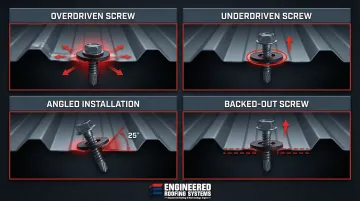
Even a 1/16-inch gap around a backed-out screw allows water infiltration. Because commercial roofs have thousands of fasteners, widespread gasket failure creates a costly, systemic problem.
Failed or Missing Sealants
Sealants applied at ridge caps, Z-flashings, roof transitions, counter flashings, reglets, and pitch pans have much shorter lifespans than the metal panels themselves. ASTM C920 sealants require periodic reapplication as part of routine maintenance, a step many building owners overlook until active leaks appear.
UV exposure causes most sealants to crack and pull away from metal surfaces within 5–10 years. Once a sealant joint opens even slightly, wind-driven rain finds its way in quickly — especially at horizontal transitions where water naturally collects.
Seam and Panel Overlap Failures
Capillary draw causes water to migrate sideways through hairline gaps where metal panels overlap, even defying gravity in small spaces. The rubber or mastic seals placed between overlapping panels during installation deteriorate from constant thermal cycling, the expansion and contraction caused by sun exposure and temperature swings.
This degradation accelerates in Southeast Texas's climate, where thermal cycling creates significant dimensional changes that fatigue seam seals.
Flashing Failures at Penetrations and HVAC Curbs
Two common flashing failure points:
- Stack flashings and pipe boots around vents and mechanical penetrations are typically made of rubberized material that lasts roughly half as long as metal panels
- Curb flashings around rooftop HVAC units where water regularly ponds on the uphill side if flashing is improperly installed or has lifted
Rust and Corrosion
Once a metal roof's protective coating degrades (from UV exposure, ponding water, or physical damage), bare metal oxidizes rapidly. Corrosion research shows that crevice corrosion frequently occurs under fastener heads and washers where stagnant moisture and high chloride concentrations accumulate.
Rust spreads laterally underneath surface coatings, weakening panels and eventually creating pinholes and structural soft spots. Humid, coastal climates like Southeast Texas accelerate this process significantly.
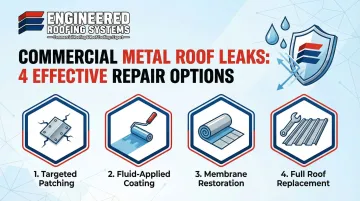
The 4 Effective Repair Options for a Leaking Commercial Metal Roof
Repair options range from minimally invasive targeted fixes to full system replacements. The right choice depends on the roof's age, damage extent, and your long-term goals for the building.
Option 1: Spot Repairs with Sealant or Patching
When this applies: Isolated leaks traced to a single failed sealant area, cracked pitch pan, damaged boot flashing, or small puncture.
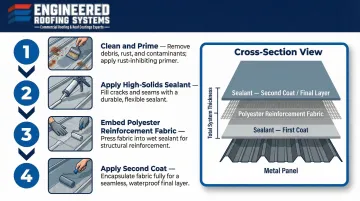
The repair process:
- Clean and prime the affected area
- Apply high-solids polyether or silicone sealant
- Embed polyester fabric into sealant at any seam that moves more than 1/8 inch
- Create a 3-course reinforced layer over the repair
Industry standards recommend this "three-course" method: applying elastic cement, embedding polyester reinforcement, and applying a second coat.
Limitations: Spot repairs are short-term solutions that address one failure point at a time. If a roof has 20+ failure points spread across its surface, individual patching becomes prohibitively time-consuming and leaves adjacent deteriorating areas untreated. Elastomeric coatings have minimal ability to cure leaks when associated with flashing conditions that experience significant repeated movement.
Option 2: Fastener and Screw Replacement
The process:
- Identify suspect fasteners through systematic inspection
- Remove old screws and apply sealant into each hole
- Install new, slightly larger screws to ensure tight seals
- Apply self-leveling sealant to encapsulate bolt heads and surrounding panels
Why this is rarely recommended as standalone: Standard commercial PBR panels require approximately 0.67 fasteners per square foot, meaning a 50,000-square-foot roof has tens of thousands of individual fasteners. Labor accounts for approximately 60% of metal roof repair costs, with rates ranging from $5 to $15 per square foot, making full fastener replacement extremely labor-intensive and expensive. It also does nothing to address the underlying seam, sealant, or corrosion issues that typically co-exist with fastener failure.
Option 3: Fluid-Applied Roof Coating System (Roof Restoration)
For commercial metal roofs that are 5–20 years old with widespread but structurally sound leaking, fluid-applied restoration is typically the most cost-effective path forward. A fluid-applied elastomeric coating is sprayed or rolled over the entire existing roof surface, forming a seamless, monolithic membrane that eliminates every seam, screw, and flashing as individual leak points simultaneously.
The installation process:
- Power wash the entire roof surface
- Replace structurally compromised metal sections
- Apply rust-inhibitor primer to any corroded areas
- Reinforce seams with fabric-embedded coating
- Apply full coating system to achieve required mil thickness
Cost comparison: Fluid-applied restoration typically costs $3.50 to $10.00 per square foot, whereas full metal roof replacement ranges from $15.00 to $35.00 per square foot—making restoration 50-70% more cost-effective than full replacement.
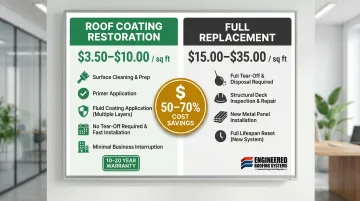
Warranty coverage: Coating systems offer 10-, 15-, or 20-year warranties based on coating thickness. For example, Carlisle X-Tenda Coat silicone coating requires 22 mils DFT for a 10-year warranty, 30 mils for 15 years, and 37 mils for 20 years.
As an authorized contractor for ASTEC, Versico, Carlisle, and Duro-Last, Engineered Roofing Systems backs its coating installations with manufacturer warranties of up to 30 years.
Energy benefits: That warranty coverage pairs well with the long-term energy savings these systems deliver. Reflective coatings can reduce metal roof surface temperatures by 40 to 60 degrees Fahrenheit, which meaningfully lowers cooling costs for large commercial facilities in Texas's hot climate.
Option 4: Full Roof Replacement
When replacement is the right call:
- Metal panels are structurally compromised by widespread rust or corrosion
- A large number of panels are loose or damaged
- The roof deck underneath has sustained water damage
- The roof has reached end of useful service life (typically 25–40 years for commercial metal)
Industry guidelines dictate that if more than 25% of the roof's insulation is wet or saturated, the roof must be replaced—it is not eligible for coating restoration. Attempting to coat or patch a structurally failing roof wastes money and delays an unavoidable expense.
What replacement involves: Tear-off of the existing system, inspection and remediation of the deck, and installation of a new metal roof system. While it represents the highest upfront cost, it resets the roof's full lifespan and allows for upgrades to better-performing panel profiles or energy-efficient materials.
Standing seam systems have projected service lives exceeding 60 years, significantly longer than exposed fastener roofs, which average 20 to 40 years.
How to Choose the Right Repair Option for Your Commercial Metal Roof
The single most important step before committing to any repair approach is a thorough professional roof inspection. A qualified inspector can assess the percentage of fasteners that have failed, map sealant degradation, measure rust spread, and probe the deck for moisture saturation. Those findings determine whether targeted repairs, a restoration coating, or full replacement is the right call.
Practical decision framework:
- Isolated leaks (1-3 failure points) and otherwise good condition → Spot repairs suffice
- Widespread fastener failure but structurally intact seams and panels → Combine fastener replacement with coating system
- Mid-life roof with generalized sealant failure and surface rust but structurally sound panels → Coating system delivers best value
- Severely corroded panels, structurally weak areas, or saturated deck → Full replacement is the only viable path
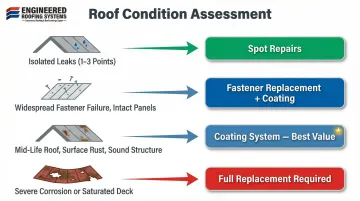
Once you've matched your roof's condition to a repair approach, the next factor to weigh is how that work affects your day-to-day operations.
Business Interruption Factor
For manufacturing plants, warehouses, and industrial facilities, the ability to keep operations running during repairs is critical. Roof coating systems take 5 to 8 days, use low-profile equipment, and keep the roof closed, resulting in minimal business interruption. Full replacement may require phased work or temporary operational adjustments—a legitimate cost consideration beyond the material estimate.
The Most Common Decision-Making Mistake
Choosing the cheapest immediate fix without accounting for long-term costs. A building owner who spends several thousand dollars on repeated spot repairs over five years—on a roof that needed a coating system—may end up paying more than restoration would have cost upfront.
Ignoring the problem entirely is worse. Interior water damage, inventory loss, and structural deterioration can easily dwarf the cost of the repair itself.
How to Prevent Future Leaks on a Commercial Metal Roof
The most cost-effective strategy is a scheduled annual or biannual inspection program. The National Roofing Contractors Association recommends inspecting commercial roofs at least twice per year, typically spring and fall, as well as immediately following severe weather events.
What inspections should include:
- Walk the roof and check all fastener heads for backing-out or cracked washers
- Probe sealant at every transition and flashing
- Inspect curb flashings after heavy rain or high-wind events
- Look for any surface rust or coating failure
Catching these issues before they become active leaks is far less expensive than emergency repairs. Engineered Roofing Systems offers maintenance programs for commercial and industrial facilities that schedule routine inspections and catch developing issues before they turn into costly repairs.
Two additional preventive practices:
- Clear roof drains and gutters of debris regularly to prevent ponding water, which accelerates rust and sealant degradation — especially during Southeast Texas's heavy rain seasons
- Budget for periodic sealant reapplication at all ridge caps, flashings, and transitions; these materials degrade faster than metal panels and are cheaper to maintain proactively
Third-party roof access is another common leak source. Any time trades workers service HVAC units, satellite dishes, solar panels, or pipe penetrations, have a roofing professional inspect afterward. Non-roofing crews frequently leave behind new fastener holes, displaced flashings, and damaged sealant without realizing it.
Conclusion
Commercial metal roof leaks almost always originate from one of a handful of predictable failure points—fasteners, seams, flashings, or sealants. Identifying the source and extent of the problem determines whether a spot repair, fastener replacement, restoration coating, or full replacement is the right investment.
For most commercial and industrial buildings with mid-life metal roofs, a fluid-applied coating system typically costs 50–70% less than full replacement while adding 10–20 years of service life, making it the most practical path for roofs in fair-to-good condition. The key is pairing the right system with a contractor who holds manufacturer authorization—so the installation is done to spec and the warranty actually holds.
Engineered Roofing Systems has been installing and restoring commercial metal roofs across Southeast Texas since 2000, with certified contractor status through Versico, ASTEC, Duro-Last, and Carlisle. If your building is dealing with active leaks or you want a professional assessment before problems worsen, reach out to the ERS team for a no-pressure inspection.
Frequently Asked Questions
What are the most common causes of metal roof leaks?
Most metal roof leaks trace back to four sources: degraded fastener gaskets, failed sealants at flashings, deteriorated seam seals, and flashing failures around penetrations and HVAC curbs. On aging roofs, these failures rarely happen in isolation — expect multiple leak points.
What is the best way to fix a leaking metal roof?
The best repair method depends on damage extent. Isolated leaks call for sealant patching, widespread fastener or sealant failure is best addressed with a fluid-applied roof coating system, and structurally compromised roofs require full replacement. Professional inspection is necessary to determine which approach is appropriate.
How much does it cost to fix a leak in a metal roof?
Coating systems typically range from $3.50 to $10.00 per square foot; full replacement runs $15.00 to $35.00 per square foot. Spot repairs cost less upfront but only address individual failure points. Costs vary by roof size, condition, and location, so get a professional inspection before budgeting.
How do you seal seams and joints on a metal roof?
Seams and joints should be thoroughly cleaned and primed before applying high-solids polyether or silicone sealant. For seams that experience thermal movement greater than 1/8 inch, polyester reinforcement fabric should be embedded into the sealant to create a flexible, 3-course waterproof layer over the seam.
How do you repair a leak on a standing seam metal roof?
Standing seam metal roofs hide fasteners within the seam profile, so leaks are most often traced to failed flashings, deteriorated sealant at penetrations, or seam separation. Repairs typically involve reflashing penetrations, resealing transitions, or applying a roof coating system to create a continuous waterproof membrane across the entire surface.
What is the life expectancy of a standing seam metal roof?
Standing seam metal roofs typically last 40–60 years — well beyond exposed fastener systems. The panels themselves rarely fail first; flashings, sealants, and coatings need periodic inspection and renewal to reach that full lifespan.