Introduction
An aging metal roof in Southeast Texas deteriorates faster than almost anywhere else in the country. Repeated thermal expansion, rust, failed seams, and water infiltration are constant threats — and the climate makes them worse.
In high-heat, high-humidity environments like Houston, Beaumont, and Galveston, UV exposure and moisture accelerate coating breakdown at rates far exceeding northern climates. Higher temperatures and humidity also increase corrosion rates on metal components, compounding the damage year over year.
Left unaddressed, roof leaks disrupt operations, damage equipment and inventory, and trap facility managers in endless repair cycles. Many owners assume full replacement is the only option — a costly misconception that can drain capital budgets and halt production for weeks when restoration would have sufficed.
This guide walks through how to evaluate your roof's condition, choose the right restoration approach, and get the most out of the investment — so you can make an informed decision before committing to a full replacement.
Key Takeaways
- Industrial metal roofs can be restored rather than replaced in most cases, saving 50-70% in upfront costs
- Key warning signs include visible rust, failed seam adhesion, recurring leaks, and rising cooling costs
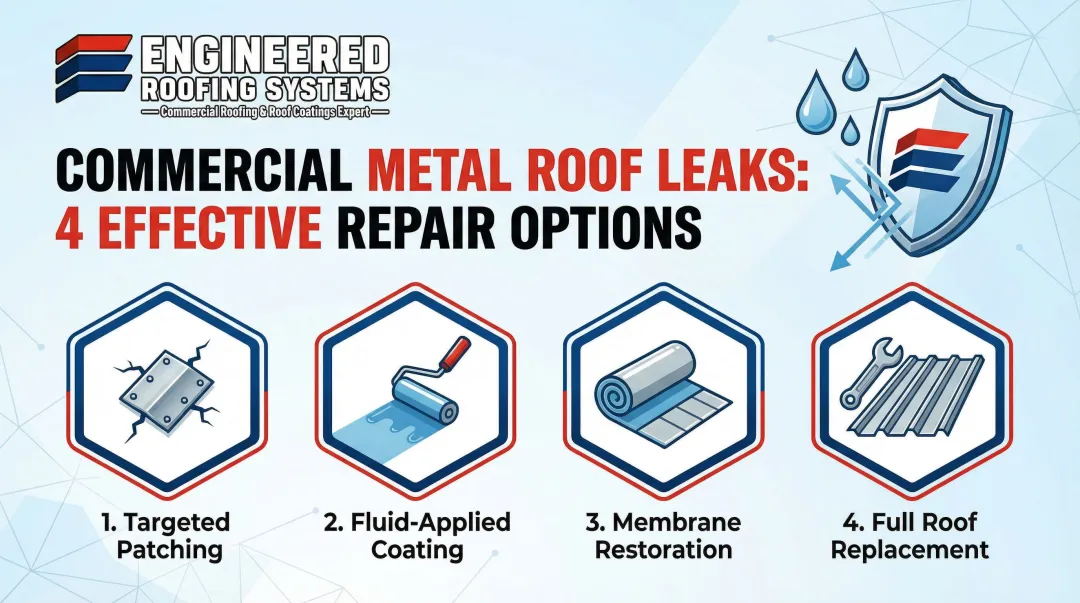
- Restoration options include elastomeric coatings, spray foam, membrane retrofits, and full replacement, each suited to a different damage level
- Professional restoration follows a set sequence: inspection, cleaning, rust treatment, primer, coating, and documentation
- Structured maintenance after restoration protects your investment and extends roof life by 10-20 years
Why Restoring Your Industrial Metal Roof Is Worth It
Done right, roof restoration is a long-term investment. When properly executed on an eligible roof, a professionally applied coating system can extend service life by 10 to 20 years. Manufacturers like ASTEC offer 10- or 15-year renewable warranties that allow the roof to be renewed at the warranty term for a fraction of the original cost—creating a sustainable, long-term roofing strategy.
Cost Comparison: Restoration vs. Full Replacement
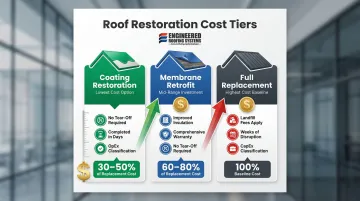
Installing a new metal roof typically costs 2 to 3 times more initially than applying a coating system. Roof restoration is generally classified as an Operating Expense (OpEx) and is typically 50-70% lower in initial cost than a full capital replacement.
Cost breakdown:
- Full removal and replacement: Carries the highest upfront CapEx — plus landfill fees, operational disruption, and structural reinforcement that can push costs even higher
- Coating restoration: Runs 30-50% of replacement cost, requires no tear-off, and is typically completed in days rather than weeks
- Membrane retrofit: Falls in the mid-tier range, offering improved insulation and comprehensive warranty coverage without a full tear-off
Energy Savings in Hot Climates
Reflective roof coatings reduce heat absorption, directly lowering cooling loads across large warehouse and manufacturing spaces. Studies by Lawrence Berkeley National Laboratory and Oak Ridge National Laboratory found that coating roofs white cuts air conditioning energy use by 10% to 50%, with the largest savings in hot climates.
The numbers hold up in the field too. Florida commercial building tests recorded a 21.9% reduction in summertime air conditioning after applying a reflective roof coating.
For industrial facilities in Southeast Texas, those savings show up directly on monthly utility bills — and in noticeably cooler conditions for workers in non-conditioned spaces. Engineered Roofing Systems has documented these outcomes across manufacturing plants and warehouses throughout the Gulf Coast region, where cooling costs are one of the largest ongoing operating expenses a facility manager faces.
Signs Your Industrial Metal Roof Needs Restoration
The sooner these signs are identified, the more restoration options remain available and the lower the intervention cost. Catching problems early often means a coating application rather than a full panel replacement.
Visible Rust, Corrosion, and Panel Deterioration
Surface rust is a warning sign, but widespread panel corrosion or pitting indicates active structural degradation—especially in steel or tin roofs exposed to Southeast Texas humidity. The critical distinction is between surface oxidation (treatable with rust inhibitor and coating) and through-panel corrosion (requires panel replacement before any coating system).
The Metal Building Manufacturers Association (MBMA) explicitly warns that metal roof panels with "substantial rusting and loss of section (the thickness of the panel) of 30% or more should not be coated". At this threshold, structural integrity is compromised and replacement becomes necessary.
What professional installers look for:
- Discoloration around fasteners (rust halos)
- Chalking or flaking of existing coatings
- White or brown streaking indicating repeated water entry
- Panel thickness measurements showing section loss
- Pitting or perforation through the metal substrate
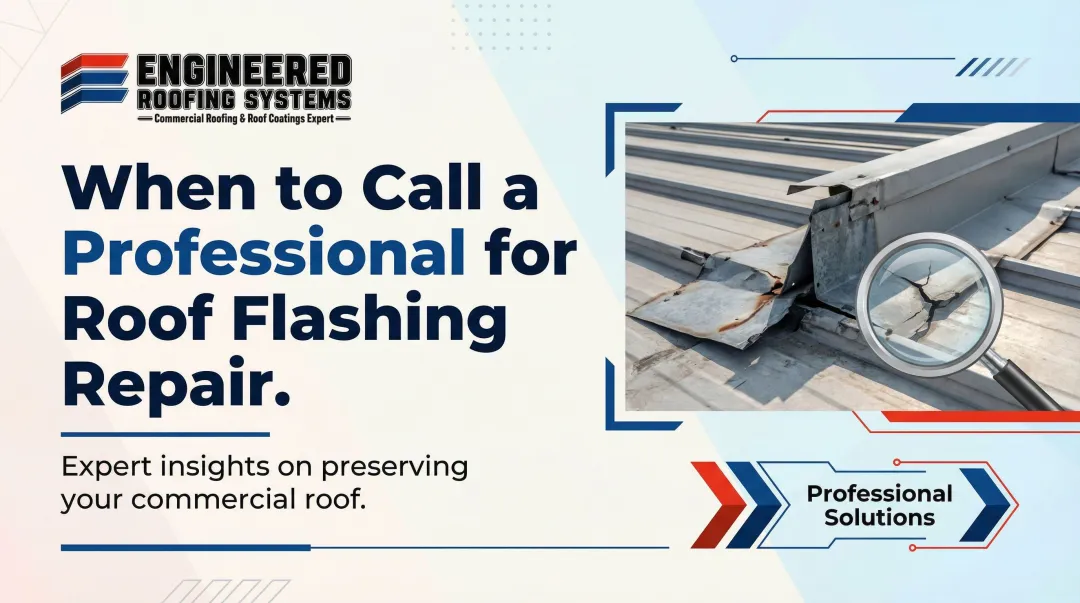
Failed Seams, Fasteners, and Flashings
Metal roofs expand and contract with temperature swings. A single metal panel exerts forces measured in tons when it tries to move thermally; restricting that movement causes attachment fatigue and failure. Over time, this cycling loosens fasteners and separates seam adhesion. These failures are among the most common sources of industrial roof leaks and are often invisible from ground level.
Signs of fastener failure:
- Raised screw heads indicating panel movement
- Stripped or missing screws
- Rust halos around fastener points
- Separated seam adhesion at panel overlaps
- Water intrusion evidence below fastener lines
Recurring Leaks and Interior Water Damage
If repairs have been made repeatedly in the same areas and leaks persist, the underlying issue is systemic rather than isolated. Interior staining, rust streaks on walls below roof level, and damage to insulation or ceiling materials all indicate the roof has been compromised for some time.
The Roof Coatings Manufacturers Association (RCMA) strictly prohibits coating over wet insulation. RCMA recommends infrared scanning to locate moisture, which must be removed and replaced before any coating is applied. Moisture issues must be resolved first — coating over them accelerates failure rather than preventing it.
Rising Energy Costs and Reduced Thermal Performance
As metal roof coatings degrade and lose reflectivity, heat absorption increases. In Southeast Texas summers, this effect is immediate and measurable. If cooling costs have risen without any change in facility operations, the roof's thermal performance has likely declined.
UV exposure breaks down the resin system, causing chalking. A chalked surface reflects far less solar radiation, and the building absorbs more heat as a result.
Industrial Metal Roof Restoration Options: What Works Best
Restoration is not one-size-fits-all. The right approach depends on the severity of damage, the percentage of compromised panels, budget, and how long the building owner needs the roof to perform. Use this framework to determine which option suits your facility.
Roof Coating Systems
Elastomeric and silicone coating systems are the most cost-effective restoration method for roofs with intact seams and limited panel damage. Coatings create a seamless, waterproof membrane over the existing metal surface—stopping rust progression and improving reflectivity, all backed by manufacturer warranties.
Eligibility requirements:
- Seams must retain adequate adhesion
- Panel section loss must be less than 30% per MBMA guidelines
- Roof should have some maintenance history
- No wet insulation beneath the metal panels
Engineered Roofing Systems is an authorized contractor for ASTEC and Versico—both manufacturers of high-performance industrial coating systems with warranties of up to 30 years. ERS has completed coating projects across Southeast Texas, including the McGee-Gibbs Building in Spring, Texas, where 8,250 square feet of metal roofing received the ASTEC Metal Roof Coating System.
Spray Foam Roofing Systems
Spray polyurethane foam (SPF) is an alternative when coatings are not viable. Foam is applied directly over the existing metal, expanding to fill every seam, fastener hole, and penetration—creating a fully seamless surface. Closed-cell roofing SPF provides a thermal resistance (R-value) of 6.2 to 6.8 per inch, offering significant thermal benefits for large industrial buildings.
SPF systems are particularly effective when seam integrity is compromised but panels remain structurally sound. The foam encapsulates the entire roof surface, eliminating thermal bridging and providing both waterproofing and insulation in a single application.
Metal Panel Retrofit or Membrane Retrofit
Retrofit systems—installing a new metal panel system or single-ply membrane over the existing roof—are mid-tier options for roofs with significant structural issues but where full tear-off is undesirable. Versico's VersiWeld TPO can be installed directly over an existing standing seam metal roof, avoiding tear-off costs and operational disruption.
Membrane retrofits include comprehensive warranty coverage and improve insulation. The higher upfront cost is typically offset by decades of lower maintenance expenses and energy savings.
Full Removal and Replacement
Full replacement is reserved for roofs where structural integrity is too compromised for any overlay system. It carries the highest cost and the longest installation timeline. It does not automatically improve insulation or reflectivity—those outcomes depend on the specific system selected.
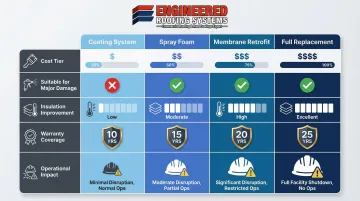
Restoration Options Comparison:
| Option | Cost Tier | Suitable for Major Damage | Insulation Improvement | Warranty Coverage | Operational Impact |
|---|---|---|---|---|---|
| Coating System | Lowest (30-50% of replacement) | No—requires intact seams and <30% panel loss | Minimal (reflectivity only) | 10-30 years | Minimal—days, not weeks |
| Spray Foam | Moderate (50-70% of replacement) | Yes—seals all penetrations | High (R-6+ per inch) | 10-20 years | Low—completed quickly |
| Membrane Retrofit | Mid-tier (60-80% of replacement) | Yes—covers existing system | Moderate to High | 10-30 years | Moderate—some access restrictions |
| Full Replacement | Highest (100% baseline) | Yes—addresses all issues | Depends on new system | 20-40 years | High—weeks of disruption |
The Step-by-Step Industrial Metal Roof Restoration Process
This walkthrough covers professional coating-system restoration—the most widely applicable approach. Surface prep and repair steps apply regardless of the method you choose.
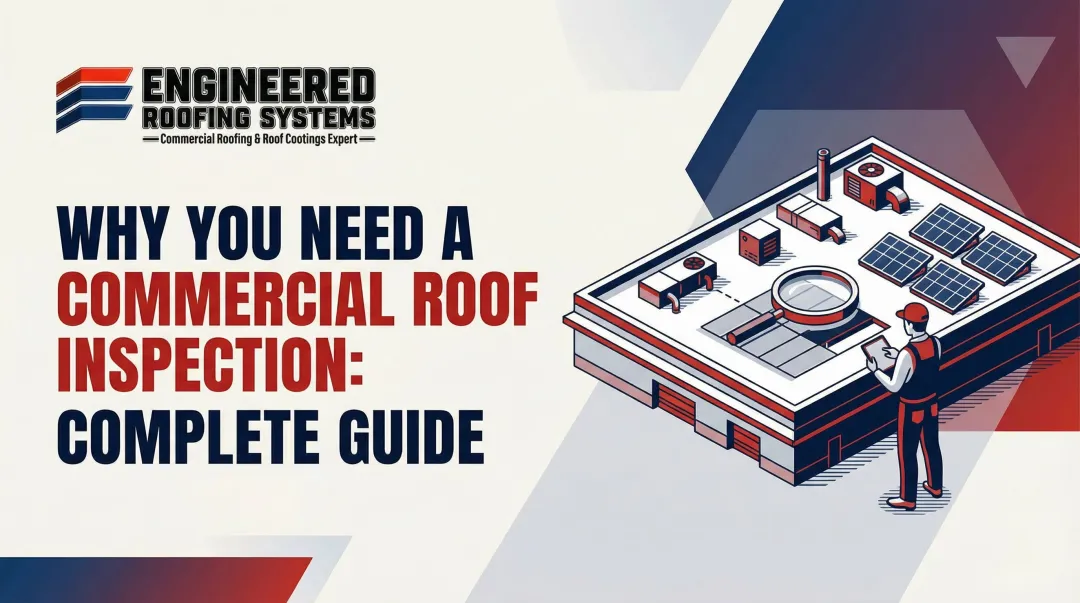
Professional Inspection and Assessment
A thorough pre-restoration inspection evaluates the roof's condition, defines the scope of repairs, and confirms whether the surface qualifies for the chosen restoration method.
Inspection components:
- Core thickness measurements to assess section loss
- Infrared scanning to identify wet insulation
- Fastener pull tests to evaluate attachment integrity
- Seam adhesion testing at representative locations
- Drainage evaluation to identify ponding water areas
Surface Cleaning and Preparation
Surface prep determines whether a coating bonds and holds—nothing else in the process comes close. Steps include pressure washing to remove dirt, debris, and loose coating; rust treatment on bare metal; and moisture testing to confirm the surface is fully dry before any product is applied.
The roof must be thoroughly cleaned and allowed to dry. Dust, chalking film, and loose debris must be removed. Weather conditions—particularly humidity and temperature—must be monitored throughout this phase, especially in Southeast Texas where morning dew and afternoon thunderstorms can interrupt work schedules.
Rust Treatment, Seam Sealing, and Structural Repairs
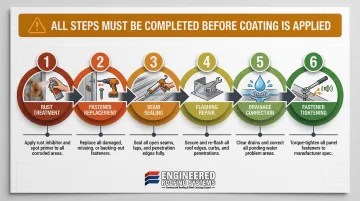
Rushing the repair phase is the single most common reason coatings fail before their time. Every item below needs to be completed before a drop of coating is applied.
Repair sequence:
- Treat rusted areas with rust-inhibiting primer on bare metal
- Replace missing or deteriorated fasteners and seal screw heads
- Seal open seams with sealant and reinforcing fabric
- Repair or replace damaged flashing around penetrations and transitions
- Address drainage or ponding issues through slope modification or drain installation
- Tighten or replace fasteners so that all metal sections are firmly held
Primer and Coating Application
The application sequence follows strict manufacturer specifications to ensure warranty compliance and long-term performance.
Application steps:
- Apply bonding primer to bare metal and repaired areas
- Apply base coating by roller or spray equipment for uniform coverage
- Embed reinforcing fabric at seams or high-stress areas if required
- Apply top coat for final weather protection and reflectivity
Thickness must meet manufacturer specifications—typically measured in mils—and qualified contractors verify coverage rates throughout. ASTEC specifications, for example, require specific dry film thickness (DFT) measurements at seams, fasteners, and field areas to ensure proper waterproofing and durability.
Post-Application Inspection and Warranty Documentation
Final quality control steps include visual inspection for uniform coverage, electronic thickness testing to verify application rates, photographic documentation of completed work, and preparation of manufacturer warranty paperwork.
A professional contractor provides maintenance recommendations and a warranty that covers roof leaks (not just coating integrity). Two examples of what manufacturer coverage looks like in practice:
- Versico: Total System Warranties covering repair of leaks
- ASTEC: Renewable warranties covering material and labor for 10 to 15 years
Post-Restoration Maintenance Schedule
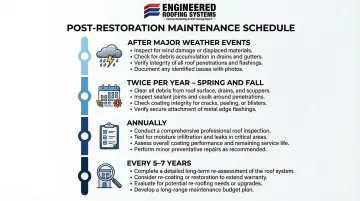
Restoration extends the roof's life, but only if followed by consistent upkeep. A maintenance plan preserves coating performance and keeps warranty coverage intact. Maintenance frequency varies by roof age, industrial environment, and climate exposure.
Maintenance Frequency Guide
After Major Weather Events:
- Inspect for physical damage, debris accumulation, and displaced flashing
- Check drain areas for blockages
- Document any impact damage from hail or wind-blown debris
Twice Per Year (Spring and Fall): The RCMA and the National Roofing Contractors Association recommend that roofs and coatings be inspected at least twice each year, preferably in the spring and fall.
- Full visual inspection of seams, fasteners, penetrations, and drain areas
- Remove debris and vegetation
- Check for chalking or coating degradation
- Verify drainage is functioning properly
Annually:
- Professional inspection with documentation
- Minor touch-up of sealant or coating at stress points
- Review warranty compliance requirements
- Update maintenance logs and photo records
Every 5-7 Years:
- Professional re-evaluation of coating thickness and condition
- Determine if re-coat is warranted before full degradation occurs
- Plan budget for renewal coating if needed
Special Considerations for Southeast Texas
High UV exposure accelerates coating breakdown faster than in northern climates. Facilities with rooftop HVAC equipment or heavy foot traffic for maintenance access require more frequent inspection of those specific zones. Drainage must be kept clear year-round given the Gulf Coast's high-volume rain events—a single clogged drain can create ponding water that compromises coating performance.
Engineered Roofing Systems has worked with industrial facilities across Southeast Texas since 2000, including Union Tank Car locations along the Gulf Coast. If you need a maintenance program built around the demands of coastal conditions, they can assess your roof and build a schedule tailored to your facility.
Conclusion
Most industrial metal roofs can be restored rather than replaced—but only when damage is caught early and addressed through the right method. The combination of proper inspection, quality surface preparation, and a warranted coating or retrofit system provides years of additional protection at a fraction of replacement cost.
Properly designed and installed modern metal roof systems have a service life of 40 to 60 years, and professional restoration extends that lifespan significantly. For industrial facilities in Southeast Texas, where heat, humidity, and coastal exposure accelerate degradation, timely restoration protects operations, equipment, and inventory while avoiding the cost and disruption of full replacement.
Engineered Roofing Systems has served manufacturers, warehouses, and industrial facilities across Southeast Texas since 2000, with over 50 years of combined team experience. ERS holds Versico Gold Medal Contractor status and has earned ASTEC Dealer of the Year recognition multiple times.
Contact ERS for a comprehensive roof inspection and restoration recommendation tailored to your facility's specific conditions.
Frequently Asked Questions
What is the best way to restore a metal roof?
A professional elastomeric or silicone coating system is the most cost-effective approach for eligible roofs with intact seams and limited panel corrosion. Spray foam or membrane retrofit are strong alternatives for roofs with more severe damage or failed seam adhesion.
How much does it cost to restore a metal roof?
Costs vary based on roof size, damage extent, and restoration method. Coating systems typically run 2 to 3 times less upfront than a full metal roof replacement, though final costs depend on roof size, damage extent, and method chosen.
Can you put a metal roof on top of an old metal roof?
Yes, both metal panel retrofits and membrane retrofit systems can be installed over an existing metal roof without full tear-off. This avoids landfill waste and reduces labor costs, provided the existing deck structure can support the added load and local building codes permit it.
How long should a commercial metal roof last?
Properly designed and installed modern metal roof systems have a service life of 40 to 60 years. A professional restoration with a warranted coating system can extend that lifespan by an additional 10 to 20 years.
Is it better to coat or replace an industrial metal roof?
Coating is preferred when the roof meets eligibility criteria: intact seams, less than 30% panel section loss, and no wet insulation. It costs 50–70% less than replacement and avoids operational disruption. Only consider replacement when structural integrity is severely compromised.
How do I know if my metal roof is eligible for a coating restoration?
Three core eligibility factors determine coating viability: seam adhesion must still be adequate, less than 30% of panel thickness can be lost to corrosion, and the roof should have some maintenance history. A professional inspection is the only reliable way to confirm eligibility.