Introduction
A commercial roof replacement on a mid-size warehouse or retail facility typically runs $50,000 to $150,000 — and that's before factoring in weeks of operational downtime, equipment relocation, and the disruption to daily business.
Most commercial roofs showing leaks, rust, or surface damage don't need to be replaced. Four proven repair methods can stop damage, restore waterproofing, and extend roof life by 10 to 20 years at a fraction of the cost of a full tear-off.
This article covers the four repair methods, how to choose the right one, and when repair is no longer the right call.
Key Takeaways
- Most commercial roof damage — including leaks, punctures, failed seams, and surface wear — can be repaired without replacing the entire system
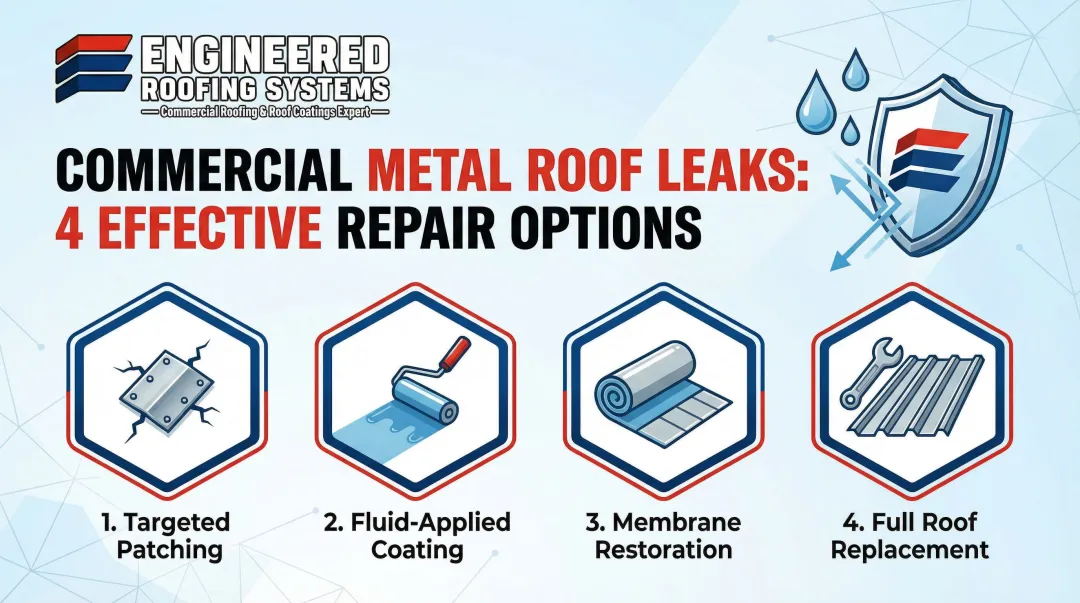
- Four proven repair methods cover the most common failure types: membrane patching, flashing resealing, seam reinforcement, and coating/restoration systems
- Roof coatings are typically the lowest-cost option for aging roofs with widespread surface deterioration
- Replacement becomes necessary only when the roof deck is compromised, damage covers more than 40–50% of the surface, or repairs would cost more than a new system
Why Commercial Roofs Break Down Before They Should
Commercial flat and low-slope roofs—common on warehouses, industrial facilities, and retail buildings—face constant exposure to UV radiation, standing water, thermal cycling, and foot traffic from HVAC maintenance. While manufacturers design these systems to last 20+ years, the average actual lifespan is just 17.4 years when maintenance is deferred.
The most common culprits behind premature failure:
- Improper installation at penetrations and seams — Poorly sealed flashing around HVAC units, skylights, and vents allows water to enter the building even when the main membrane is intact
- Deferred maintenance — Minor issues like small leaks or loose seams compound over time, turning a $500 repair into a $50,000 replacement
- Southeast Texas climate — High humidity, intense UV exposure, and hurricane-season wind loads accelerate deterioration of sealants, membranes, and fasteners faster than in milder regions
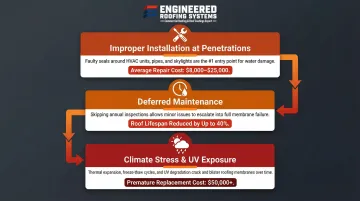
Most of these failure points are localized — and that matters. A seam separation in one section doesn't mean the entire roof has to come off, and a puncture from hail or debris rarely requires a full tear-off. Where the damage is and how far it has spread determines which repair method makes sense.
4 Commercial Roof Repair Methods That Avoid Replacement
The right repair method depends on where the damage is, how widespread it is, and what the roof is made of. These four methods address the most common failure scenarios on commercial flat and low-slope roofs.
Method 1: Localized Membrane Patching
What it addresses: Punctures, tears, and blisters in TPO, EPDM, PVC, or modified bitumen membranes caused by foot traffic, falling debris, hail, or UV degradation.
The repair process: Clean the damaged area, cut away compromised material, apply a matching membrane patch using adhesive or heat welding, and seal the edges. The patch must extend at least 2 to 3 inches beyond the damaged area in all directions, with rounded corners to prevent peeling.
When this method is appropriate:
- Damage is isolated to a specific area (under 25% of total roof surface)
- The surrounding membrane is in good condition
- The roof deck is dry and structurally sound
Material compatibility rules to follow: Mismatched patch materials are one of the most common reasons repairs fail early. Key incompatibilities to know:
- PVC cannot contact bituminous materials (asphalt or coal tar) — they must be separated
- TPO and PVC products cannot be mixed
- Always use manufacturer-matched materials and follow installation specs
Important threshold: Firestone/Elevate guidelines state that if a membrane sustains more than six punctures within any 100-square-foot area, the entire area must be overlaid or replaced rather than patched.
Method 2: Flashing Repair and Resealing
Why flashing failures are so common: Flashing failures—at parapet walls, HVAC equipment bases, skylights, vents, and roof edges—are among the most common entry points for water on commercial roofs. In fact, a major FM Global study found that 59% of built-up roof losses occurred because the roof perimeter failed.
Sealant degrades over time from UV exposure and thermal cycling, leaving gaps that allow water intrusion even when the membrane itself is intact.
The repair process:
- Remove deteriorated sealant
- Clean and prime the substrate
- Install new flashing material or apply fresh sealant
- Verify watertight integration with the adjacent membrane
This is often the fix when "repeat leaks" occur at the same penetration points.
Why proactive inspection pays off: Flashing is one of the most overlooked items on commercial roofs. The NRCA and major manufacturers recommend inspecting commercial roofs at least twice per year—preferably spring and fall—and immediately after severe weather events. Catching sealant failure early is far cheaper than repairing the structural damage that follows.
Method 3: Seam Repair and Reinforcement
What causes seam separation: On single-ply membranes (TPO, PVC, EPDM), seams joined by heat welding or adhesive can open up over time due to thermal expansion and contraction, wind uplift, or poor original installation. This creates long, linear gaps where water can enter the building.
Repair options by membrane type:
- TPO and PVC: Heat welding — re-weld separated seams with a hot-air gun using proper temperature settings and overlap dimensions
- EPDM systems: Adhesive-based repair with seam tape — clean the surface, apply primer, and install manufacturer-compatible seam tape
Why professional technique matters: Seam repairs require professional equipment and technique. Improper heat settings or insufficient overlap will cause the repair to fail again. EPDM repairs require thorough cleaning and specific primers/splice washes to remove dirt and oxidation; failure to prep the smooth factory finish results in adhesive failure.
When seam repair is sufficient: If seam separation is confined to a few specific areas and the rest of the membrane is intact, targeted seam repair is the right solution. However, widespread seam failure across the roof signals a deeper problem—either poor original installation or general membrane deterioration—that may require a restoration system or replacement.
Method 4: Roof Coating and Restoration Systems
What roof coatings address: Roof coatings (also called fluid-applied restoration systems) are the most comprehensive non-replacement repair solution for commercial roofs with:
- Widespread surface deterioration
- Minor ponding risk
- Rust on metal panels
- UV-damaged membranes
A coating system applies a seamless, fully adhered liquid membrane over the existing roof, restoring waterproofing without tearing off the old system.
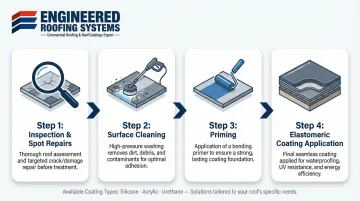
The restoration process:
- Thorough inspection and minor spot repairs first
- Cleaning the surface
- Priming
- Applying one or more coats of elastomeric material (silicone, acrylic, or urethane-based)
Energy savings benefit: Coatings also reduce heat absorption—a real advantage for commercial buildings in Texas where summer cooling bills run high. A Florida Solar Energy Center demonstration on a commercial strip mall measured a 25.3% average reduction in summer space cooling energy after applying a white reflective coating.
ERS and coating systems: Engineered Roofing Systems holds authorized contractor status with Versico, Carlisle, and ASTEC, and has earned ASTEC Dealer of the Year recognition multiple times. ERS has installed restoration coatings across Southeast Texas — from manufacturing plants to multi-facility commercial clients — qualifying building owners for manufacturer warranties of up to 30 years. The ASTEC Re-Ply system ERS installs carries 10- or 15-year renewable labor and material warranties, extendable through a recoat application.
How to Choose the Right Repair Method for Your Roof
The starting point is always a professional inspection. A proper assessment checks for moisture in the insulation layer (using infrared scanning or core samples), maps the full extent of damage, and evaluates the roof deck condition. Without this baseline, there's no reliable way to match the right repair method to the actual problem.
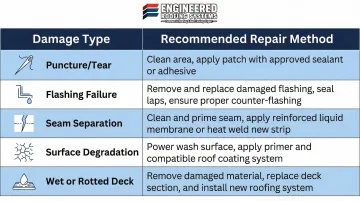
Simple decision framework:
| Damage Type | Recommended Method |
|---|---|
| Localized punctures or tears (intact surrounding membrane) | Membrane patching |
| Flashing failures at penetrations or perimeter edges | Flashing repair and resealing |
| Seam separations across the roof | Seam repair and reinforcement |
| Widespread surface degradation, structurally sound deck | Roof coating/restoration system |
| Wet or rotted deck or insulation | Replacement likely required |
Key factors to consider:
- Whether damage is confined to one area or spread across the roof
- Whether the surrounding membrane, insulation, and deck are still in good condition
- How much useful life remains in the system given the roof's age
- Whether cumulative repair costs are approaching the cost of a full replacement
ERS performs roof inspections and assessments for commercial and industrial facilities across Southeast Texas, so building owners have a clear picture of what they're dealing with before committing to any repair spend.
When Repair Isn't Enough: Signs You Need Replacement
Some roofs are simply past the point where repair makes financial sense. Watch for these conditions:
- The roof is over 20–25 years old with widespread membrane failure
- Moisture has saturated the insulation layer across a large portion of the roof
- The structural deck shows signs of rot or corrosion
- Cumulative repair costs are approaching 50% of replacement cost
The 25% Rule of Thumb
When damage is widespread, repairs stop being cost-effective. Many roofing professionals use a practical threshold: if more than 25–40% of the roof area requires repair or has compromised insulation, replacement is typically the smarter long-term investment. Some jurisdictions also enforce this through building code — if more than 25% of the total roof area is repaired, replaced, or recovered within any 12-month period, the entire roof system must conform to current code requirements, which can trigger a mandatory full replacement.
Code-Driven Replacement Requirements
Beyond the 25% threshold, the International Building Code (IBC) mandates a full tear-off to the deck under two specific conditions:
- The existing roof already has two or more layers of roof covering
- The existing roof is water-soaked or deteriorated to the point it can no longer serve as a stable base
Even when full replacement is required, a recover — installing a new membrane directly over the existing one — can reduce cost and disruption, provided the roof has only one existing layer and the insulation is dry. An experienced commercial roofing contractor can assess whether recover is code-compliant for your specific situation before committing to a full tear-off.
Frequently Asked Questions
What is a common reason for roof system failure in commercial buildings?
Flashing failures and inadequate drainage (ponding water) are among the leading causes, often worsened by deferred maintenance, UV degradation of sealants, and improper original installation at penetrations.
Can you repair just a section of a roof?
Yes, localized repairs are appropriate when damage is confined and the surrounding membrane and deck are intact. Patching or flashing repair on the affected section is often all that is needed.
What is the best product to repair a flat roof?
The best product depends on your roof type. Membrane patches suit punctures, manufacturer-compatible sealants address flashings, and fluid-applied elastomeric coatings — silicone, acrylic, or urethane — handle widespread surface restoration.
What is the life expectancy of a commercial flat roof?
Most commercial flat roof systems last 15–25 years depending on materials and maintenance. Regular inspections and timely repairs can extend a well-maintained roof to 25 years or more.
How do I know if my commercial roof needs repair or full replacement?
The key factors are the extent of damage (localized vs. widespread), the condition of the insulation and deck, the roof's age relative to its expected lifespan, and whether cumulative repair costs approach the cost of a new system.
How much does commercial roof repair cost compared to full replacement?
Localized repairs typically range from a few hundred to a few thousand dollars, and coating restoration systems cost far less than replacement. Full replacement runs $4.00–$13.00 per square foot depending on material type, putting a 10,000-square-foot roof at $40,000–$130,000 or more.