Introduction
Industrial metal roofs represent one of the most significant capital assets for manufacturing plants, warehouses, and distribution centers across Southeast Texas. Without structured, proactive care, even a well-installed metal system will deteriorate well ahead of its expected lifespan.
The cost of neglect adds up fast: water infiltration, spreading rust, fastener failure, and rising energy bills can push a facility toward full roof replacement years too soon. A single undetected leak can damage inventory, corrode equipment, and create liability exposure that far exceeds the cost of routine inspections.
This guide covers the most important maintenance tasks for industrial metal roofs, warning signs that demand immediate attention, and a practical inspection schedule tailored to the operational realities of industrial facilities in Southeast Texas.
Key Takeaways
- Inspect industrial metal roofs twice a year minimum—plus immediately after major storms or high-wind events
- Core maintenance priorities: clear drains, check fasteners, treat rust early, seal penetrations, maintain protective coatings
- Pooling water, rust streaks at seams, and rattling panels are warning signs that need immediate attention
- Preventive maintenance typically costs 10–25% of what emergency repairs or early replacement runs
- In Southeast Texas's high-heat, high-humidity climate, reflective coatings and corrosion control are critical for long-term performance
Why Industrial Metal Roof Maintenance Matters
The financial gap between preventive and reactive maintenance is dramatic. A 15-year study by Firestone Building Products and ProLogis found that proactive maintenance costs $0.14 per square foot annually, compared to $0.25 per square foot for reactive maintenance—a 44% cost difference. For facilities managing 50,000 to 100,000 square feet of roofing, that translates to thousands of dollars in annual savings. Emergency leak repairs carry labor premiums 3 to 5 times higher than planned maintenance, and that doesn't account for downtime, inventory damage, or operational disruption.
Lifespan is where the impact becomes even clearer. Well-maintained industrial metal roofs typically last 30 to 40 years or longer, while poorly maintained roofs may require replacement in half that time—sometimes as soon as 10 to 14 years. The difference is measured in decades, not years, and proper maintenance is what allows a roof to reach or exceed manufacturer warranty periods.
Protecting a roof's lifespan and controlling costs both depend on one often-overlooked factor: coating integrity. As protective coatings degrade, industrial metal roofs absorb significantly more solar heat, driving up cooling costs for large facilities. A Lawrence Berkeley National Laboratory study on a 100,000 sq. ft. retail building in Austin, Texas, found that applying a highly reflective coating dropped peak roof surface temperatures from 168°F to 126°F—a 42°F reduction.
That single coating application resulted in an 11% decrease in air-conditioning energy consumption and a 14% drop in peak demand, saving the facility approximately $7,200 annually. In Southeast Texas, where high-UV intensity and summer heat push HVAC systems hard, keeping coatings in good condition is one of the most cost-effective maintenance decisions a facility manager can make.
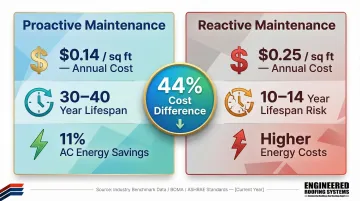
The three core reasons to stay on top of metal roof maintenance:
- Cost control — Proactive maintenance runs 44% cheaper per square foot than reactive repairs
- Longevity — Regular upkeep can double a roof's serviceable life
- Energy savings — Intact reflective coatings directly reduce cooling loads and peak demand charges
Essential Maintenance Tasks for Industrial Metal Roofs
Industrial metal roofs face greater wear than residential systems. Larger roof spans, more penetrations, heavy foot traffic from HVAC servicing, and exposure to industrial byproducts like chemical vapors, oil residue, and soot all accelerate deterioration. The following tasks form the foundation of any effective maintenance program.
Inspect the Roof Bi-Annually—and After Every Major Storm
A proper inspection covers:
- Panel surface condition - Look for dents, scratches, and rust formation
- Fastener status - Check for backing-out screws, rust rings, and compressed washers
- Sealant and caulk integrity - Inspect all penetrations for cracking or shrinkage
- Flashing condition - Examine edges, transitions, and termination points
- Drainage assessment - Identify any signs of pooling or water staining
Texas Gulf Coast properties face hurricane-season damage that can look minor from the ground but compromise the entire system. Wind uplift, panel displacement, and sealant failure often aren't visible without a rooftop inspection.
Document each inspection with dated photos. This creates a condition history that helps identify gradual deterioration patterns, supports warranty claims, and establishes a baseline for assessing whether post-storm damage is new or pre-existing.
Clear Drains, Gutters, and Roof Valleys Regularly
Industrial environments generate debris that clogs drainage faster than typical buildings. Sawdust, metal shavings, insulation fragments, and industrial dust accumulate in valleys and downspouts. Standing water accelerates panel corrosion and puts structural load on unsupported areas.
Clear drainage pathways monthly in high-debris industrial settings and verify that water drains fully within 24 to 48 hours of rainfall. Any persistent ponding beyond this window warrants a professional assessment.
It typically signals either a blocked drainage pathway or structural deflection in the roof deck—both of which accelerate panel corrosion and, in severe cases, create structural load risk.
Check and Replace Failing Fasteners
On exposed fastener systems—the most common configuration for industrial metal buildings—screws are fitted with neoprene sealing washers that compress and crack over time. Signs of failing fasteners include:
- Rust staining around screw heads
- Lifted panel edges
- Screws that have backed out and left visible gaps
- Compressed or cracked washers
Neoprene washers typically degrade within 15 to 20 years, but fasteners should be evaluated every 5 years. When replacing fasteners, use screws designed specifically for metal roofing with the correct thread type, washer gauge, and corrosion resistance rating. In coastal Southeast Texas environments, upgrading to stainless steel fasteners provides superior corrosion resistance.
Inspect and Reseal All Roof Penetrations
Industrial roofs contain significantly more penetrations than residential roofs—HVAC curbs, exhaust fans, electrical conduit, vent pipes, and skylights each create a potential leak point. Repeated thermal expansion and contraction cycles in large metal roof spans stress the sealant around these openings faster than in smaller structures.
Deteriorated sealant is identifiable by:
- Cracking or shrinking
- Pulling away from the flashing collar
- Hardening or loss of elasticity
- Visible gaps or separation
To address failing sealant, remove old caulk fully, clean the surface to bare metal, and apply a sealant rated for metal roofing and your facility's thermal environment. Proper surface preparation is non-negotiable: new sealant won't bond to old residue or contaminated surfaces.
Treat Rust and Corrosion as Soon as It Appears
Rust spreads faster in industrial contexts. Chemical vapors, salt-laden air in coastal Texas facilities, and humid Gulf Coast conditions all accelerate oxidation. Distinguish between surface rust (treatable) and structural corrosion (requires professional assessment).
For surface rust, take immediate action:
- Wire brush the affected area to bare metal
- Apply a rust-inhibiting primer at the manufacturer's recommended dry film thickness
- Finish with a topcoat specifically formulated for metal roofs
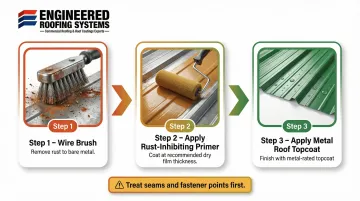
Untreated rust at seam lines or fastener points can compromise panel integrity and void warranties—so prioritize these locations first.
Maintain Protective Roof Coatings (and Know When to Reapply)
Reflective and elastomeric coatings serve as an industrial metal roof's primary defense layer. They block UV degradation, slow rust formation, reduce heat absorption, and extend the life of the underlying metal. Coating failure is often invisible until leaks or rust appear, making periodic assessment critical.
For industrial facilities across Southeast Texas, working with an authorized contractor like Engineered Roofing Systems—which applies ASTEC, Versico, and other manufacturer-backed coating systems—ensures the right product is matched to the roof type, climate conditions, and warranty requirements. Coatings through authorized contractors can carry manufacturer warranties of up to 30 years, provided application standards and surface preparation requirements are met.
Warning Signs Your Industrial Metal Roof Needs Attention
Industrial facilities often miss early warning signs because roof surfaces aren't easily visible from the ground and inspections aren't prioritized. Catching these indicators early is the difference between a repair job and a full replacement.
Visible Leaks or Interior Water Staining
Active leaks are almost always a late-stage warning sign. By the time water appears on the ceiling or walls inside a facility, moisture has likely been infiltrating the roof system for some time. Water can enter through failed fastener washers or unsealed laps, then travel laterally along purlins or become trapped in the insulation layer.
Any new staining or dripping should trigger an immediate roof inspection, not a "monitor it" response. Delayed action allows moisture to saturate insulation, corrode structural members, and damage inventory or equipment.
Rust Streaks, Discoloration, or Staining on Panel Surfaces
Distinguish between surface-level staining (from organic debris or oxidized metal on adjacent structures) and genuine panel corrosion. Rust appearing at fastener locations, seam lines, or panel edges is especially serious because it indicates the protective coating has failed at the most structurally critical points.
A quick way to tell them apart:
- Surface staining — typically washes off during cleaning; caused by debris or runoff from adjacent materials
- Rust at fasteners or seams — indicates active corrosion requiring immediate treatment to prevent spread
- Panel edge rust — often signals coating failure at the most vulnerable points of the roof assembly
Pooling Water That Doesn't Drain Within 24–48 Hours
Standing water on a metal roof points to one of two problems: a blocked drainage pathway or structural deflection (sagging) in the roof deck. Both conditions accelerate panel corrosion and, in extreme cases, add structural load risk to the building.
The NRCA defines positive roof drainage as the condition where no ponding water remains on the roof 48 hours after precipitation. Persistent ponding beyond this window warrants professional assessment.
Loose, Rattling, or Visibly Buckled Panels
Common causes include fastener pullout, wind uplift events, or thermal expansion beyond the panel's movement tolerance. A loose panel is no longer weather-tight — and in the next wind event, it's at real risk of further uplift or complete detachment.
Rattling sounds during wind are an early indicator that warrants inspection before the next storm season. In Southeast Texas, loose panels detected before storm season can be re-secured at a fraction of the cost of post-storm emergency repairs.
Industrial Metal Roof Maintenance Schedule
How often you maintain a metal roof depends on three variables:
- Roof age — older systems need more frequent attention as fasteners and coatings wear
- Environmental exposure — coastal, chemical, or high-humidity environments (like Southeast Texas) accelerate deterioration
- Roof type — exposed fastener systems require more regular fastener review than concealed fastener or standing seam systems
Facilities in the Houston and Gulf Coast region should build in extra inspections for high-UV summers and hurricane season.
Use this schedule as your baseline, then adjust based on the variables above:
| Frequency | Tasks |
|---|---|
| After every major storm or high-wind event | Inspect for lifted panels, new debris blockages, impact damage, and fresh leak points inside the facility |
| Monthly | Clear drains, gutters, and roof valleys of debris; perform quick visual scan for new staining or pooling water |
| Semi-annually (spring and fall) | Full surface inspection covering fasteners, sealant, flashings, penetrations, coating condition, and rust formation; document with photos |
| Every 5–7 years | Professional fastener evaluation and coating reapplication assessment—plan recoating before the existing coating fails entirely |
| Every 15–20 years | Comprehensive structural assessment and re-roof evaluation (or when repair costs approach 30% of replacement value) |
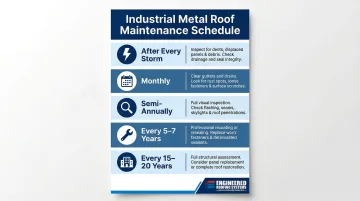
Facilities where HVAC crews access the roof regularly should add a quarterly visual check. Foot traffic is a common source of sealant disturbance around curbs and penetrations that standard semi-annual inspections can miss.
Conclusion
An industrial metal roof is a long-term investment, but its lifespan depends entirely on how consistently it's maintained. Proactive programs pay off. Facilities that schedule regular inspections and upkeep typically see:
- Extended roof lifespan by decades
- Lower energy costs through reflective coating systems
- Fewer emergency repairs and unplanned operational disruptions
- Better protection for equipment, inventory, and personnel
For industrial facilities in Southeast Texas looking for a reliable maintenance partner, Engineered Roofing Systems offers long-term maintenance programs, professional inspections, and coating systems backed by manufacturer warranties designed for the region's climate. Contact ERS at 281-404-2211 to schedule an assessment before the next storm season.
Frequently Asked Questions
What maintenance do industrial metal roofs require?
Industrial metal roofs require at least two inspections per year covering drain clearing, fastener checks, rust treatment, penetration resealing, and periodic recoating. In harsh industrial or coastal environments, more frequent attention is needed to address accelerated corrosion and coating wear.
How often should you replace the screws on an industrial metal roof?
Neoprene-washered screws on exposed fastener systems should be evaluated every 5 years and typically need replacement around the 15 to 20 year mark. Replace sooner if rust rings, compressed washers, or backed-out screws are found during inspection.
How do you prevent industrial metal roofing from getting so dirty?
Trim overhanging vegetation, keep drains clear to prevent pooling, and apply a smooth reflective coating to reduce buildup. Twice-yearly low-pressure washing with a mild detergent prevents dirt and organic matter from bonding to the surface.
How long do industrial metal roofs last with proper maintenance?
Well-maintained industrial metal roofs typically last 30 to 40 years or longer, depending on metal type and coating quality. Roofs that receive little or no maintenance may need replacement in as few as 10 to 14 years.
What are the signs that an industrial metal roof needs immediate repair?
Active interior leaks, visibly loose or displaced panels, standing water after 48 hours, and rust at seams or fastener points all require prompt attention. Schedule a professional inspection within days of spotting any of these conditions.
Should industrial metal roofs be inspected after major storms in Southeast Texas?
Yes, post-storm inspections are essential. Wind events and hail can cause panel uplift, impact dents, and sealant displacement that isn't visible from the ground but will cause leaks and accelerated deterioration if left unaddressed.