Introduction
Your commercial roof represents one of the largest capital investments your business will make—yet it's often the last asset inspected until a leak forces emergency action. By that point, what could have been a $2,000 repair has become a $50,000 replacement.
Most building owners know "regular inspections" are recommended, but few grasp what's actually at stake when they skip them: voided manufacturer warranties, denied insurance claims, and replacement costs that arrive years ahead of schedule.
This guide covers what commercial roof inspections actually involve, what they catch, and how to use them to protect your building—and your budget—before small problems become expensive ones.
Key Takeaways
- Commercial roof inspections cover membranes, flashing, drainage, insulation, and structural components
- Inspections twice per year catch small issues before they become costly replacements
- Skipping inspections voids warranties, invites insurance denials, and opens the door to water damage and structural failure
- Southeast Texas heat, humidity, and storm seasons accelerate roof wear faster than most climates
- Inspection costs are a fraction of emergency repair expenses
What Is a Commercial Roof Inspection?
A commercial roof inspection is a systematic, professional evaluation of all components of your roof system—including the surface membrane, flashings, drains, seams, penetrations, insulation, and decking—performed by a qualified roofing contractor.
Inspectors physically assess your roof and document what they find. A written report follows, covering condition findings, repair urgency, and recommended next steps. During the walkthrough, inspectors look for:
- Ponding water and blocked drains
- Blistering, cracking, or exposed seams
- Compromised flashings and rust
- Deteriorated coatings
- Signs of interior moisture infiltration
Regular inspections shift roof management from reactive to planned. Instead of calling a contractor after a leak appears, you know exactly what needs attention—and when—before small problems become expensive repairs.
Key Benefits of Regular Commercial Roof Inspections
The following benefits directly affect your business's bottom line through measurable operational and financial outcomes.
Early Problem Detection Prevents Expensive Repairs
Trained inspectors identify issues like failed flashing, membrane separations, clogged drains, and early-stage leaks long before they cause interior water damage—the point at which repair costs multiply dramatically.
Consider a contractor walking your roof who spots a hairline seam separation or deteriorated sealant around an HVAC penetration. Left unaddressed for one storm season, that becomes a leak damaging insulation, decking, and interior inventory.
The financial case is straightforward:
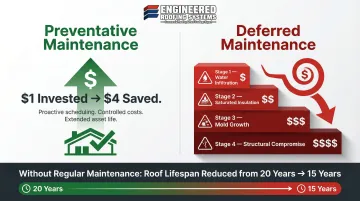
- For every $1 spent on preventative maintenance, building owners save an estimated $4 in future repairs
- Roof damage compounds: water infiltration leads to saturated insulation, mold growth, and structural compromise, with each stage adding cost
- Neglecting routine maintenance can reduce a commercial roof's lifespan from 20 years down to 15 years, forcing premature capital expenditures
KPIs impacted: Repair cost per incident, emergency maintenance spend, downtime from interior water damage events
When this benefit matters most: Especially critical for facilities with expensive equipment, inventory, or sensitive operations, such as warehouses, manufacturing plants, and data rooms, where a single leak event causes disproportionate losses.
Extended Roof Lifespan — Avoiding Premature Replacement
Commercial roofs are designed to last 15–30+ years depending on material, but deferred maintenance consistently shortens that lifespan. Annual inspections and small targeted repairs are the most reliable path to realizing full expected service life.
Inspections unlock this advantage by catching coating failures, membrane fatigue, and drainage issues early. Contractors can then apply targeted repairs or protective roof coatings that restore performance without triggering full replacement.
- Commercial roof replacements range from $5.50 to $16.00 per square foot, making replacement a significant capital expense
- Roof restoration and coating systems cost between $3.00 and $5.50 per square foot, representing 50%–70% savings compared to full tear-off
- For many commercial buildings in Southeast Texas, a qualified inspection followed by a roof coating application can add years of service life at a fraction of replacement cost
Engineered Roofing Systems has built its maintenance programs around this approach since 2000, helping Southeast Texas facilities extend roof life and push back costly replacements through regular inspections and targeted coatings.
KPIs impacted: Roof replacement cycle length, capital expenditure timing, cost-per-year of roof ownership
When this benefit matters most: Most impactful for roofs approaching the 10–15 year mark, where the decision between repair/coating and replacement becomes financially significant.
Compliance, Warranty Protection, and Insurance Eligibility
Most commercial roofing manufacturer warranties—including those from Versico, Carlisle, and Duro-Last—require documented, regular inspections as a condition of coverage. Failing to maintain inspection records can void warranty claims exactly when they're needed most.
Many commercial property insurers also require proof of routine maintenance to honor storm damage claims. Without that documented history, carriers can deny or reduce payouts following severe weather events. In hurricane-prone Southeast Texas, this is a risk no facility manager can afford to overlook.
- Warranty claim denials and insurance disputes are frequently triggered by lack of documented maintenance
- Texas building codes may require roofs to meet specific performance standards, particularly in hurricane-prone areas
- Pre- and post-event inspection reports strengthen insurance claims after storm, hail, or wind damage
KPIs impacted: Warranty claim approval rate, insurance premium impact, liability exposure from safety-related roof failures
When this benefit matters most: Critical for any building with active manufacturer warranties, commercial insurance policies, or tenants whose lease agreements include habitability and safety obligations.
Warning Signs Your Commercial Roof Needs an Inspection Now
Watch for these visible and operational warning signs that indicate your roof needs immediate inspection:
- Interior water stains or active leaks — even small stains signal membrane failure
- Bubbling or blistering on the membrane surface — indicates trapped moisture beneath the roofing material
- Sagging or deflection in the roof deck — suggests structural compromise or saturated insulation
- Visible rust or corrosion on metal components — especially around fasteners, flashing, and penetrations
- Sudden increases in energy bills — often indicates insulation failure allowing heat transfer
- Damaged or missing flashing — around penetrations, edges, or parapet walls
In Southeast Texas's climate—extreme UV exposure, high humidity, and hurricane-force winds—these symptoms appear faster and escalate more quickly than in milder regions. Prompt inspection after any major weather event is essential.
None of these signs automatically mean replacement. An inspection determines whether targeted repairs or a coating system can restore the roof—but the longer they go unaddressed, the fewer cost-effective options remain.
What Happens When Commercial Roof Inspections Are Skipped
Deferred inspections follow a predictable pattern: small issues remain undetected and grow. The first signal building owners typically receive is an interior leak—by which point damage has already spread to insulation, decking, and potentially structural components, all far costlier to repair than the original roof defect.
Water intrusion into active commercial facilities — offices, warehouses, retail spaces, industrial plants — doesn't stop at the building itself. It disrupts operations, damages inventory or equipment, and creates real safety and liability exposure for employees and tenants.
The financial and legal consequences stack up fast:
- Voided manufacturer warranties
- Denied insurance claims
- Failed building inspections
- In severe cases, structural failure requiring emergency evacuation
Each of these outcomes is preventable — routine inspections catch the problems that turn into these costs before they escalate.
How to Get the Most Value from Your Commercial Roof Inspection
Inspection value compounds when applied consistently. A one-time inspection gives you a snapshot; annual or bi-annual inspections (recommended in storm-prone regions) build a documented history of your roof's condition, making it far easier to plan capital spending, file warranty claims, and demonstrate maintenance compliance to insurers.
The inspection report is only useful if its recommendations are acted on. A detailed report identifying early-stage issues that goes unaddressed for a year provides no protective value. Treat the report as a maintenance action plan, not a filing document.
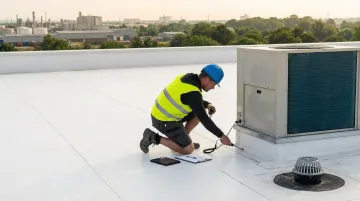
Executing that action plan well starts with the right contractor. Engineered Roofing Systems has served commercial and industrial facilities across Southeast Texas since 2000, delivering inspections that go beyond a visual walkthrough. A thorough inspection covers:
- Roof surface condition, seams, and flashing integrity
- Drainage areas and ponding water risk zones
- Core sampling or infrared scans to detect hidden moisture
- Photographic documentation of current issues and projected lifespan
- Clear repair or replacement recommendations tied to specific findings
That combination of documentation and follow-through is what turns an inspection into a real maintenance program — one that protects your facility and your budget over the long term.
Frequently Asked Questions
Why do I need a commercial roof inspection?
Commercial roofs face constant exposure to weather, UV, and physical wear that causes progressive, often invisible damage. Inspections catch those issues before they become expensive repairs, warranty violations, or insurance problems.
How much do commercial roof inspections cost?
Inspection costs vary based on roof size, type, and location, but typically cost far less than a single undetected leak repair or early roof replacement. Many contractors offer inspection as part of maintenance agreements.
How often should a commercial roof be inspected?
At least once annually for most commercial roofs, and twice for older roofs or those in storm-prone regions like Southeast Texas — ideally before and after hurricane season.
How long does a commercial membrane roof last?
Most commercial membrane roofs (TPO, EPDM, PVC) last 15–30 years depending on material quality and maintenance history. Regular inspections and timely repairs are what determine whether a roof reaches — or exceeds — that range.
What are the 4 types of commercial roof inspections?
The four common types are:
- Visual inspection — surface and component assessment
- Moisture survey — infrared or nuclear scanning for trapped moisture
- Drone inspection — aerial imagery for large or hard-to-access roofs
- Core sampling — material analysis to assess insulation and deck condition
What happens if I skip my commercial roof inspection?
Skipping inspections allows minor issues to escalate undetected, risks voiding manufacturer warranties and insurance coverage, and often results in far higher repair or replacement costs.