Introduction
Picture this: a facility manager in Houston walks into the building on a Monday morning after a weekend storm and spots a brown water stain spreading across the ceiling tiles. It wasn't there on Friday. This is how most commercial roof failures begin—not with a dramatic collapse, but with subtle warning signs that go unaddressed until they become expensive problems.
Commercial roofs in Southeast Texas face particularly brutal conditions. The combination of intense UV exposure, high humidity, heavy rain events, and extreme heat accelerates material breakdown faster than in most other regions. Catching problems early keeps repair costs manageable — ignoring them often turns a $3,000 fix into a $50,000 replacement.
This article breaks down seven specific warning signs your commercial roof needs attention, so you can act before a small issue turns into a full replacement.
Key Takeaways
- Commercial roofs last 15–30 years, but Texas heat and storms shorten that window
- Seven key warning signs range from visible surface damage to rising energy bills
- One sign may warrant repair; multiple signs together usually point to replacement
- A professional inspection is the only reliable way to determine the true scope of damage
- Roof coatings often extend roof life and delay full replacement when damage is caught early
7 Signs Your Commercial Roof Needs Attention
Some warning signs are immediately visible from ground level. Others develop slowly and show up inside the building first. Both deserve urgent action—waiting only multiplies the damage and the cost.
Sign 1: Active Leaks or Water Stains on Ceilings and Walls
Interior water stains are often the first symptom building owners notice. By the time staining appears, water has already penetrated multiple layers of the roofing system. The actual source of the leak may be 10 to 100 feet from the stain, traveling horizontally along metal deck flutes before finally dripping through the ceiling.
Left unaddressed, the damage compounds quickly:
- Mold begins growing within 24-48 hours of water infiltration
- Wet insulation loses up to 70% of its thermal performance with just 4% water absorption
- Electrical hazards develop when moisture reaches wiring
- Structural deterioration worsens with every rain event
Sign 2: Ponding or Standing Water on the Roof Surface
Flat and low-slope roofs—common in commercial construction—are especially vulnerable to poor drainage. If water remains pooled more than 48 hours after rainfall, it accelerates membrane breakdown and creates structural loading risk. One inch of standing water adds 5.2 pounds per square foot of dead load to your roof structure.
In Texas, heavy summer storms can quickly overwhelm drainage systems. The two most common causes are clogged drains and inadequate roof slope, and both require professional evaluation to prevent the "ponding cycle"—where accumulated water increases deflection, which increases the capacity of the depression, creating a feedback loop that can lead to roof collapse.
Sign 3: Blistering, Bubbling, or Cracking on the Roof Surface
Blisters and bubbles form when moisture or air becomes trapped beneath the roofing membrane—whether TPO, EPDM, or modified bitumen. Poor installation, aging material, or inadequate ventilation are common culprits. In Texas's extreme heat, the process accelerates dramatically.
How blisters grow:
- Daytime heat causes trapped air and moisture to expand, stretching the warm membrane
- Nighttime cooling stiffens the membrane, creating a partial vacuum
- The vacuum draws more air and moisture through micro-cracks
- The blister grows with each heat cycle
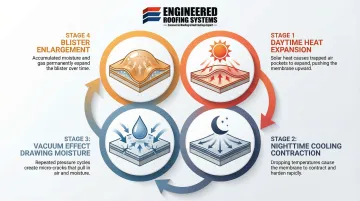
Small, isolated blisters may be repairable. Widespread blistering across multiple sections is a strong replacement indicator. Cracks in the membrane expose the insulation layer directly to water infiltration, creating urgent risk.
Sign 4: Damaged or Deteriorated Flashing
Up to 90% of commercial roof leaks originate at flashings and penetrations, not the field membrane—a figure that catches most building owners off guard. Flashing seals the vulnerable transition points where the roof membrane meets walls, HVAC curbs, vents, skylights, and parapets. When flashing lifts, separates, or corrodes, water has a direct entry point that bypasses the membrane entirely.
Flashing damage is frequently underestimated because it's not always visible from the ground. Watch for these common indicators:
- Lifted or separated flashing at parapet walls and roof edges
- Corrosion or rust staining around HVAC curbs and vent penetrations
- Visible gaps where the membrane meets vertical surfaces
- Cracked or missing caulk at skylight frames and pipe boots
Flashing issues around rooftop HVAC units are particularly common in commercial and industrial buildings, where foot traffic and equipment vibration accelerate wear.
Sign 5: Visible Storm or Wind Damage
After any significant weather event—hail, high winds, or tropical storms (all common in Southeast Texas)—the roof should be inspected even if no interior damage is visible yet. Hailstone impact can create micro-punctures in TPO and PVC membranes that only reveal themselves during the next rain. Aged, embrittled membranes are especially susceptible to shattering upon impact.
Note the date of any major storm and schedule a professional post-storm inspection within a few days. Under the Texas Prompt Payment of Claims Act, insurers must acknowledge claims within 15 days, but timely reporting with documented damage assessments strengthens your position significantly.
Sign 6: Roof Age Nearing or Past Its Expected Lifespan
Even a roof with no obvious visible damage becomes increasingly vulnerable as it approaches the end of its material lifespan. Here are typical ranges for common commercial roofing materials:
| Material Type | Expected Lifespan |
|---|---|
| TPO | 15–25 years |
| EPDM | 15–30 years |
| PVC | 20–30 years |
| Modified Bitumen | 15–25 years |
| Built-Up Roofing | 20–30 years |
Poorly maintained roofs reach failure faster. A roof over 15–20 years old with no maintenance history should be treated as high-risk and inspected immediately, regardless of visible condition.
Industry data consistently shows that roofs with regular maintenance programs last an average of 8 years longer than those managed reactively.
Sign 7: Unexplained Spikes in Energy Bills
This sign is often missed because owners attribute rising costs to other factors. When a roofing membrane is compromised or insulation is saturated with moisture, the building's thermal barrier breaks down. HVAC systems work harder to compensate, and energy costs climb without any obvious operational change.
In Texas's intense summer heat, a compromised roof can significantly increase cooling loads. Just 4% water absorption in insulation can reduce thermal performance by 70%, and saturated insulation can increase heating and cooling costs by 20% to 40%. Water conducts heat approximately 25 times more efficiently than trapped air.
Repair or Replace? Making the Right Call
The core decision framework is straightforward: repair is appropriate when damage is isolated and the roof has remaining service life. Replacement becomes necessary when damage is widespread, the roof is aging, or cumulative repair costs are approaching replacement cost.
The 25% Rule in Commercial Roofing
Under the 2021 Houston Amendments to the International Existing Building Code (IEBC), if more than 25% of a roof's surface has been repaired or is damaged, code officials generally push for full replacement over continued patching. This threshold exists because additional layers add weight and cost without addressing the root issue. In some jurisdictions, reroofing more than 25% triggers mandatory structural evaluations and potential code upgrades.
Roof Restoration and Coating: The Middle Ground
For roofs in structurally sound condition but showing surface wear, an elastomeric or reflective roof coating can extend service life, seal minor weak spots, and reduce heat absorption — at a fraction of replacement cost. This option only works when the underlying structure is still sound.
Engineered Roofing Systems installs the ASTEC Re-Ply system as an authorized ASTEC contractor. It's worth considering if your roof qualifies, since the coating:
- Forms a seamless, waterproof membrane over the existing roof surface
- Incorporates ceramic technology for UV resistance and ponding water protection
- Qualifies for renewable warranty coverage
Quick Decision Reference:
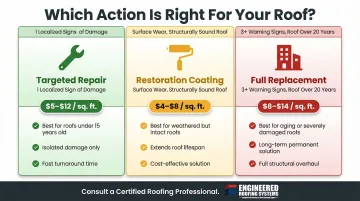
| Scenario | Recommended Action |
|---|---|
| 1 localized sign, roof under 15 years | Targeted repair |
| 3+ signs, roof over 20 years | Full replacement |
| Surface wear on structurally sound roof | Restoration/coating |
Estimated Costs (2025/2026):
- Targeted repair: $5–$12 per sq. ft.
- Elastomeric/silicone coating: $4–$8 per sq. ft.
- Full replacement (TPO/EPDM): $8–$14 per sq. ft.
How Texas's Climate Accelerates Roof Damage
Southeast Texas's climate is among the most punishing in the country for commercial roofing materials. Houston averages 51.84 inches of rainfall annually, UV index peaks at 10.3 in June, and summer highs regularly hit 94.9°F in August. The stressors compound each other:
- UV exposure degrades membrane surfaces and accelerates oxidation in coatings
- High humidity traps moisture in roofing assemblies, promoting mold and deck rot
- Heavy rain events stress drainage systems and expose low points to prolonged ponding
- Temperature swings drive constant thermal expansion and contraction across the entire roof surface
Flat and low-slope roofs—dominant in commercial and industrial construction—are particularly vulnerable because they trap heat and drainage is slower than on pitched roofs. That thermal cycling puts significant stress on membrane seams over time, eventually causing seam separation and material fatigue.
Rooftop HVAC equipment, common in warehouses and manufacturing facilities, creates additional foot traffic and penetration points that accelerate wear. For industrial building owners, that makes proactive inspection a necessity rather than a precaution.
Common Mistakes Commercial Building Owners Make
The "Wait and See" Approach
Many owners only act after interior damage is already visible — by which point the repair scope and cost have multiplied. Early intervention on even one sign typically costs far less than addressing secondary damage like mold remediation, insulation replacement, and ceiling repair.
DIY or Deferred Patching
Sealant patches over recurring problem areas can mask the true scope of damage, making it harder for a professional to assess the underlying condition. Worse, unauthorized repairs can void manufacturer warranties. Major manufacturers like CertainTeed and Johns Manville explicitly state that DIY patching invalidates coverage unless carried out with prior written approval by a certified contractor.
Skipping Post-Storm Inspections
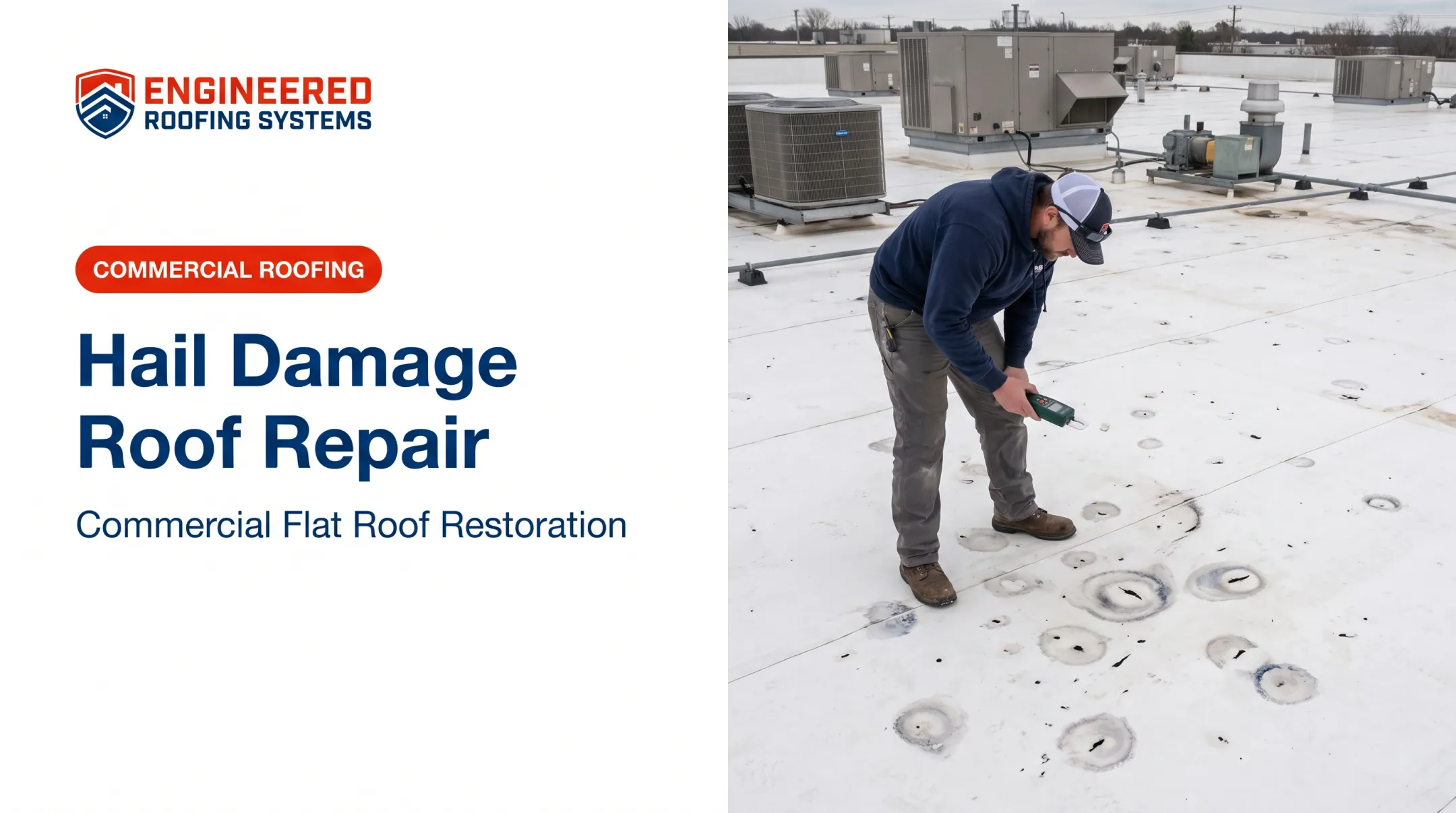
In Texas's hail and hurricane corridor, skipping a post-storm inspection is a costly mistake. Insurance claims require timely, documented damage assessments — and many carriers will deny claims without them. Small hail damage often presents as circular crack patterns that aren't immediately obvious but quietly compromise waterproofing, only becoming apparent during the next heavy rain.
A few things commonly missed without a professional post-storm assessment:
- Bruised or fractured membrane seams that hold water
- Compromised flashing at rooftop equipment penetrations
- Granule loss on modified bitumen or built-up roof sections
- Pooling patterns that shift after structural settling
When to Schedule a Professional Roof Inspection
Commercial roofs should be professionally inspected at minimum twice per year (spring and fall), and immediately after any major storm—not only when a problem is visible. Many issues only become detectable through infrared scanning or close-up membrane examination that goes beyond a visual walkthrough.
What a Professional Inspection Includes:
- Detailed written assessment with photographic documentation
- Evaluation of drainage, flashing, seams, and membrane health
- Core sampling or infrared scans to identify hidden moisture issues
- Prioritized repair or replacement recommendations
Engineered Roofing Systems offers free commercial roof inspections across Southeast Texas. The team brings over 50 years of combined experience and holds multiple manufacturer awards, including Versico Gold Medal Contractor (three consecutive years) and ASTEC Dealer of the Year.
Service covers Houston, Montgomery County, Harris County, and surrounding areas within a 100-mile radius, including Conroe, Katy, The Woodlands, Galveston, and College Station.
If you recognize any of the seven signs in your own building, schedule an inspection promptly, before the next storm season makes the problem worse.
Frequently Asked Questions
How do I know if my commercial roof needs repair or replacement?
The decision depends on the number of signs present, the roof's age, and whether damage is localized or widespread. A professional inspection is the only reliable way to determine the right course of action.
What is the average life of a commercial roof?
TPO and EPDM roofs typically last 15–25 years, PVC lasts 20–30 years, and built-up roofing lasts 20–30 years. Regular maintenance and Texas's climate both affect how long a roof actually lasts — well-maintained roofs can last several years longer than neglected ones.
What is the 25% rule in commercial roofing?
The 25% rule states that if more than 25% of a roof's surface has been repaired or is damaged, full replacement is recommended over continued patching — additional layers add weight and cost without fixing the underlying problem.
How often should a commercial roof be inspected?
Professional inspections should occur at least twice yearly (spring and fall), plus an immediate post-storm inspection after any significant weather event in Texas. Many issues are only detectable through infrared scanning or close membrane examination.
Can a roof coating extend the life of a commercial roof instead of replacing it?
High-performance roof coatings can extend roof life and improve energy efficiency when the underlying structure is still sound. However, coatings are not a substitute for replacement when the membrane is severely deteriorated or the deck is compromised.
What causes a commercial flat roof to fail prematurely?
The main causes are poor initial installation, lack of regular maintenance, and storm damage left unaddressed. In Texas, prolonged UV exposure and heat cycling degrade roofing materials faster than in cooler climates, cutting years off an otherwise sound roof.