Introduction
Commercial and industrial facilities across Southeast Texas routinely wait until a visible leak forces action. By that point, water has already spread through insulation, damaged inventory, and compromised structural systems, turning a modest repair into a full replacement event.
Most facility managers know their roof needs attention. What's missing is a structured inspection and repair schedule that catches problems before they escalate.
This guide covers when to schedule commercial roof inspections, when to act on repairs, how timing varies by scenario, and what mistakes to avoid to protect both the roof and the business.
Key Takeaways
- Commercial roofs require inspection twice yearly minimum—before and after Texas storm season (June–November)
- Schedule repairs immediately after inspection findings during stable weather windows
- Delaying confirmed repairs accelerates deterioration and multiplies total repair cost
- Align inspection and repair schedules with operational cycles to reduce facility disruption
- Documented inspection records support warranty claims and give you negotiating leverage when repair costs arise
Why Timing Matters for Commercial Roof Inspections and Repairs
Commercial and industrial roofs—particularly the large flat membrane and metal roofs common in Southeast Texas—face constant stress from UV intensity, heat, and Gulf Coast humidity. Small failures compound faster on these systems than most facility managers anticipate, making timing the single most controllable variable in long-term roof performance.
The Cost and Risk Impact
An undetected leak in a warehouse or manufacturing facility damages insulation, inventory, and interior systems. The numbers make the case clearly:
- Proactive maintenance runs $0.14/sq ft annually vs. $0.25/sq ft for reactive maintenance — a savings of $0.11 per square foot
- Roof replacement costs roughly four times more than localized repair
- Proactively maintained roofs average a 21-year lifespan; reactively maintained roofs average only 13 years
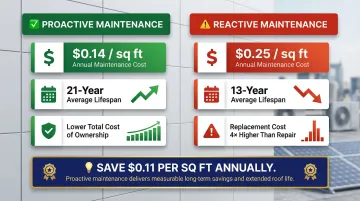
A minor seam separation left unaddressed becomes a full system failure.
Moisture infiltration also reduces thermal, wind, and hail resistance, driving up both repair scope and replacement cost when problems go undetected.
Warranty Compliance
The financial exposure doesn't stop at repair costs. Timing also determines whether your warranty remains valid when you need it most. Most manufacturer warranties require documented periodic inspections to remain valid. Major manufacturers like Carlisle, Versico, and Duro-Last explicitly require semi-annual inspections (spring and fall) and immediate post-storm inspections to maintain No Dollar Limit (NDL) warranty validity. Skipping or delaying those inspections voids coverage on materials built to last 20–30 years.
When to Schedule: Best Timing Based on Scenarios
There is no single universal answer. The best time to schedule depends on the season, the roof's current condition, and the facility's operational calendar—all three factors must be considered together.
Based on Season and Climate
Two optimal inspection windows exist for commercial roofs in Southeast Texas:
Early Spring (March–April):
- Schedule before Gulf storm activity intensifies and peak heat arrives
- Allows time for calm-weather repairs on vulnerable flashings, seam separations, and drainage systems before storms test those weaknesses
- Addresses winter moisture damage before summer heat compounds it
Late Fall (October–November):
- Schedule after storm season ends to identify accumulated damage
- Catches hidden damage that may not yet be leaking but will deteriorate through the following year if left unaddressed
- Prevents winter moisture from compounding undetected issues
The regional storm season roughly spans June through November, with the Atlantic Hurricane Season officially running from June 1 to November 30. The peak occurs between mid-August and mid-October, with September 10 identified as the statistical peak. Pre- and post-season timing is non-negotiable for commercial properties in this region.
Based on Roof Age and Condition
Newer Commercial Roofs (Under 5 Years, Properly Installed):
- Warrant semi-annual inspections as the baseline
- Single-ply membranes (TPO, PVC, EPDM) can last 20–30 years when properly maintained
Aging Systems (10+ Years) or Prior Repair History:
- Benefit from quarterly checks
- Metal roofs with active rust risk or flat roofs with a history of ponding water require more frequent monitoring regardless of age
Condition-Based Triggers Override the Calendar:
- Surface blistering
- Visible rust streaking
- Ponding water
- Interior staining
Any of these signs warrants an inspection now, not at the next scheduled date.
Based on Operational and Business Cycles
Scheduling repairs around your facility's rhythm reduces disruption and keeps work moving efficiently. Key considerations:
- Align repair windows with low-production periods, planned shutdowns, or low-inventory cycles
- Coordinate with operations leadership before booking so crews have uninterrupted roof access
- Build inspection and repair costs into the annual maintenance budget so findings can be acted on promptly—not deferred because the expense wasn't planned
Signs Your Commercial Roof Needs an Inspection or Repair
Visible Surface Signals
These demand immediate attention:
- Flat roofing membranes: Blistering, cracking, or bubbling
- Metal roofs: Rust streaks, seam separations, or fastener corrosion
- Ponding water: Water remaining 48 hours or more after rain
The NRCA Roofing Manual states that no ponding water should remain on the roof 48 hours after a rain event during conditions conducive to drying. Prolonged ponding leads to structural load issues, deck deflection, and microbial growth.
Interior Building Signals
These indicate an active or progressing problem:
- Water stains on ceilings
- Damp or deteriorating insulation
- Musty odors near the roofline
- Unexplained increases in cooling costs (a sign that roof membrane or insulation integrity has been compromised, allowing heat transfer into the building)
Post-Event Triggers
After any major storm, high-wind event, or confirmed hail in the Gulf Coast region, schedule a professional inspection within days. Approximately 70% of storm-related roof damage cannot be identified from ground level—distance distorts perspective, and the most vulnerable areas (roof valleys, areas behind HVAC units) are completely hidden from standard ground views. Storm damage worsens with every subsequent rain event before it is detected.
The 12-Month Rule
The absence of a documented inspection within the past 12 months is itself a reason to act. A professional assessment gives facility managers a verified baseline, identifies repair priorities, and establishes a credible maintenance record—something Engineered Roofing Systems provides for commercial and industrial properties across Southeast Texas.
Timing Mistakes That Lead to Costly Roof Damage
Treating Inspections as Optional
The most damaging mistake: treating commercial roof inspections as optional until a visible problem forces action. Reactive-only scheduling consistently results in repairs that are larger in scope, more disruptive to operations, and far more expensive than if the same damage had been caught during a routine inspection.
Patching Without a Full Inspection
Scheduling repairs based on isolated visible symptoms without a full inspection first is risky. Patching a single visible leak without assessing the surrounding condition leaves adjacent damage unaddressed — resulting in repeat service calls, continued water intrusion, and compounding costs within months.
Scheduling Repairs During Unsuitable Weather
Repairs attempted during unsuitable weather conditions compromise material adhesion, sealing performance, and coating cures. GAF notes that TPO/PVC adhesives fail when temperatures exceed 90°F (condensation and excessively fast drying) or drop below 30°F (material stiffness and excessively slow drying).
Weather Thresholds for Common Commercial Roofing Materials:
| Material | Minimum Temp | Critical Condition |
|---|---|---|
| Water-Based / Low-VOC Adhesives | Dew point ≥5°F below ambient | Apply above dew point to prevent adhesive blushing (condensation) |
| Acrylic Roof Coatings | Above 50°F | Must hold above 50°F for 4+ hours post-application to prevent freeze damage |
| Silicone Roof Coatings | As low as 34°F | Substrate must be dry; application on wet surfaces causes delamination |
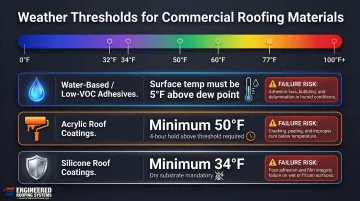
In the humid Gulf Coast climate, failing to monitor the 5°F dew-point margin during early morning or late afternoon repairs will result in trapped condensation and adhesive failure.
Best Practices for Scheduling Commercial Roof Inspections and Repairs
Establish a Documented Inspection Calendar
Schedule formal inspections twice per year aligned with the Texas climate cycle (spring and fall) as the baseline. Treat post-storm inspections as non-negotiable events rather than optional follow-ups. Every inspection should produce a written report with photos, findings, and a repair priority list.
Prioritize Repairs Using Urgency Tiers
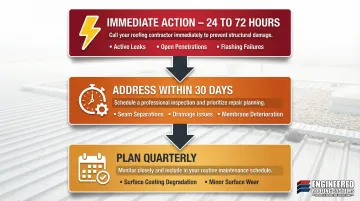
Once findings are documented, assign every repair item to a response tier:
Immediate Action (Within 24–72 Hours):
- Active leaks
- Open penetrations
- Flashing failures that allow water entry
Address Within 30 Days:
- Seam separations
- Drainage issues
- Membrane deterioration
Plan on a Quarterly Basis:
- Surface coating degradation
- Minor wear
Align Repair Scheduling with Facility Operations
Coordinate with operations or facility management to identify the lowest-disruption windows for roofing work. Shift changes, planned shutdowns, and off-peak hours are all good candidates. Scheduling around these windows protects production schedules, equipment access, and inventory flow.
Enroll in a Structured Long-Term Maintenance Program
A formal maintenance agreement with a qualified commercial contractor removes the burden of tracking schedules internally. It keeps inspections on time, repair findings documented, and costs predictable.
Engineered Roofing Systems provides structured maintenance programs for industrial and commercial facilities across Southeast Texas, covering scheduled inspections, prioritized repair management, and ongoing compliance support.
Verify Warranty Compliance at Every Inspection Cycle
Confirm that inspection activities and all repairs are documented in a format that satisfies the requirements of the applicable manufacturer warranty. For commercial roofs installed with systems from manufacturers like Versico, Carlisle, Duro-Last, or ASTEC, this documentation is essential to keeping the warranty enforceable and protecting the long-term value of the roofing system.
Frequently Asked Questions
How often should a roof be inspected?
Commercial roofs should be inspected at minimum twice a year—before and after storm season—with additional inspections required after major weather events or rooftop work. Older roofs or those with prior repair history may warrant quarterly checks.
How much do roofers charge for an inspection?
Commercial roof inspection costs vary based on roof size, complexity, and accessibility. National averages range from $250 to $1,000. Many contractors include inspections within a maintenance program or offer a complimentary assessment when scoping repair work.
What maintenance should be done on a roof?
Essential maintenance tasks include clearing drains and removing debris, checking flashing and seam integrity, addressing ponding water, re-caulking penetrations, and applying protective coatings or sealants based on roof type, age, and local climate conditions.
How to quote roof repair?
An accurate repair quote requires a professional inspection first—not just a visual scan of the obvious damage—so the estimate reflects the full scope of the problem and avoids return visits for issues the initial look missed.
What should I not say to a roofing insurance adjuster?
Avoid these three missteps before your adjuster visit:
- Admitting to a history of deferred maintenance
- Speculating on the cause of damage before a professional inspection
- Accepting a damage assessment without an independent contractor evaluation on record