Introduction
Industrial roofs in Southeast Texas face some of the harshest conditions in the country. Intense UV exposure, high humidity, heat cycling, and coastal air create an environment where even minor maintenance oversights turn into expensive problems fast. A small crack in a seam or a corroded fastener may seem insignificant, but in this climate, these issues escalate quickly.
The two biggest threats to industrial roofs in this region are leaks and corrosion. Left unaddressed, both create compounding business costs:
- Operational disruption when equipment or inventory gets damaged
- Interior structural deterioration over time
- Shortened roof lifespan
- Risk of premature full replacement
The financial stakes are real. Liquid damage is the number one cause of losses in the commercial property sector, responsible for 58% of losses in finished facilities between 2012 and 2022.
This guide covers the top threats facing industrial roofs, the types of maintenance that matter, warning signs you shouldn't ignore, and a practical maintenance schedule designed for Southeast Texas conditions.
Key Takeaways
- Industrial roofs in Southeast Texas face accelerated wear from heat, UV exposure, and humidity
- Preventive maintenance costs a fraction of reactive repairs or full replacement
- Failed seams, flashing, and clogged drains are the most common entry points for water infiltration
- Moisture and chemical exposure in this region cause metal corrosion to accelerate fast
- Schedule professional inspections at least twice a year — and after every major storm
Why Industrial Roof Maintenance Matters
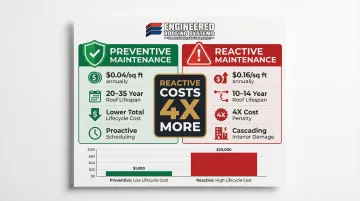
Industrial roofs protect far more than the building structure. They shield equipment, inventory, personnel, and daily operations. When a roof fails, the damage cascades through all these areas disproportionately. Reactive roof repairs cost $0.16 per square foot annually compared to just $0.04 per square foot for preventive maintenance — a 4X cost penalty for waiting until problems become visible.
A well-maintained industrial roof can serve its full expected lifespan of 20–35 years, while an unmaintained roof may fail in just 10–14 years — cutting the asset's useful life in half. That gap represents hundreds of thousands of dollars in premature replacement costs, plus the operational disruption of an unplanned re-roof.
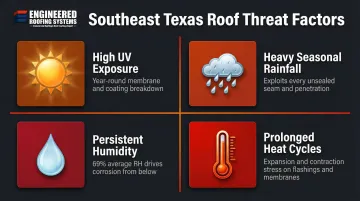
Southeast Texas climate conditions accelerate roof wear faster than most regions. Port Arthur averages 62.13 inches of annual precipitation, while Houston maintains 69% average relative humidity. For manufacturing plants, warehouses, and industrial campuses in the region, these conditions combine into a persistent threat:
- High UV exposure breaks down membrane surfaces and coating adhesion year-round
- Heavy seasonal rainfall exploits any unsealed penetration or seam gap immediately
- Persistent humidity drives corrosion on metal decking and fasteners from below
- Prolonged heat cycles cause expansion and contraction stress on flashings and membranes
Routine maintenance isn't optional in this environment — it's the difference between a roof that hits 30 years and one that fails at 12.
Top Threats to Industrial Roofs: Leaks and Corrosion
Water Infiltration Points
Leaks on industrial flat and low-slope roofs most commonly originate at three critical points:
Seams and membrane breaches develop as temperature swings cause repeated expansion and contraction. That stress weakens adhesive bonds and opens separation points where water enters. On single-ply membrane systems common in Texas warehouses, these failures start small but spread rapidly once moisture reaches the substrate.
Flashing failures around roof penetrations — HVAC units, vents, skylights, and pipe penetrations — are the second major vulnerability. Industrial facilities have numerous rooftop penetrations, and the seals around them degrade over time, creating gaps that allow water infiltration even when the main membrane looks intact.
Blocked or failed drainage systems cause ponding water, which accelerates membrane degradation and adds structural load. On flat industrial roofs common in Texas manufacturing plants, poor drainage is one of the most frequent causes of early roof failure.
The Ponding Water Problem
The National Roofing Contractors Association defines ponding as water remaining on the roof 48 hours after precipitation. This threshold matters because standing water:
- Accelerates membrane breakdown through constant moisture exposure
- Adds significant structural load that can cause deck deflection
- Promotes biological growth that physically and chemically attacks the membrane
- Creates expanding wet areas as the deck deflects further under increased load
Metal Roof Corrosion
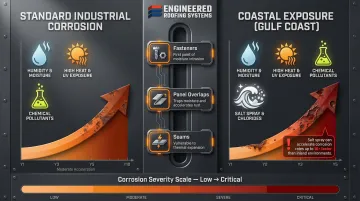
Corrosion represents a distinct and serious threat on metal industrial roofs. In Southeast Texas, the combination of heat, humidity, and airborne moisture creates ideal conditions for rust to develop at seams, fasteners, and panel edges. Chemical exposure from industrial processes — particularly in manufacturing facilities or railcar repair operations — accelerates corrosion.
Salt spray from breaking waves and onshore winds significantly accelerates the rate of corrosion of metal connectors and fasteners. For facilities near Galveston and other Gulf Coast locations, this coastal exposure compounds the humidity problem, attacking exposed metal at fastener penetrations and panel overlaps.
Mechanical Damage
Heavy foot traffic, rooftop equipment servicing, and debris impact from industrial operations all cause membrane damage that standard commercial roofs rarely face. Manufacturing plants and warehouses with regular HVAC servicing, equipment maintenance, and material handling see accelerated wear as a result.
Common mechanical damage sources include:
- Maintenance crew foot traffic on unprotected membrane areas
- Impact from dropped tools or rooftop equipment servicing
- Debris from adjacent industrial operations or high-wind events
Types of Industrial Roof Maintenance
Effective industrial roof maintenance isn't a single action but a layered approach. The right combination depends on roof age, material type, facility use, and climate exposure.
Preventive Maintenance
Preventive maintenance is scheduled, proactive work done before problems develop. This foundation includes:
- Regular professional inspections
- Debris and drainage clearing
- Flashing re-sealing
- Fastener checks and tightening
- Surface cleaning to remove biological growth
For Southeast Texas industrial facilities, preventive maintenance should also include periodic application of reflective or elastomeric roof coatings. These coatings seal the membrane surface, stop early-stage rust on metal roofs, reduce heat absorption, and can extend roof life significantly. Engineered Roofing Systems is an authorized contractor for ASTEC and Versico — two coating systems built for demanding climates that address both leak prevention and corrosion control in a single application.
Corrective / Reactive Maintenance
Corrective maintenance is triggered by a known issue: a visible leak, failed seal, or post-storm damage. While sometimes unavoidable, relying on this approach alone carries serious risks.
Water infiltration causes cascading damage to insulation, structural decking, and interior assets before a leak becomes visible from inside. By the time you see water stains on the ceiling, the damage has typically been progressing for weeks or months.
Reactive-only strategies cost significantly more over a roof's lifecycle than proactive programs — and that gap reflects direct repair costs alone, not the operational disruption and interior damage that compound the total.
Predictive / Condition-Based Maintenance
Predictive maintenance monitors the roof's condition using inspection data, coating assessments, or infrared moisture scanning to schedule work based on actual wear rather than a fixed calendar.
This approach is particularly valuable for large industrial facilities managing multiple rooftop systems across warehouses, manufacturing plants, or industrial campuses. Condition-based maintenance identifies problems at the earliest stage — when repairs are simplest and least expensive.
Major Overhaul / Re-Roofing
Major overhaul becomes necessary when there's widespread membrane failure, severe corrosion across metal panels, or structural decking compromise. A full re-roof or metal-over-metal overlay can often restore the roof without full tear-off, reducing cost and downtime for active industrial facilities that can't afford extended shutdowns.
Warning Signs Your Industrial Roof Needs Immediate Attention
Exterior Signs
- Rust streaks or surface corrosion at seams, fasteners, and panel overlaps on metal roofs
- Blistering, cracking, or separation of membrane material on flat roofs
- Debris accumulation blocking drains or gutters
- Lifted or buckled flashing around penetrations
- Visible membrane tears or punctures from foot traffic or debris impact
Interior Warning Signs
Interior signs mean water is already getting in — and damage has likely been building for months:
- Water stains or wet spots on ceilings and walls
- Mold or musty odors near the roofline
- Damp insulation (which loses R-value and wind uplift resistance)
- Efflorescence (white mineral deposits) on walls or structural members
Operational and Structural Red Flags
When warning signs escalate beyond moisture and surface damage, structural and operational red flags signal a roof that needs professional assessment without delay:
- Sagging roof sections
- Pooling water visible after rain that doesn't drain within 48 hours
- Recurring leaks in the same location after prior repairs
- Unusual creaking or deflection when walking on the roof
- Sudden increases in cooling costs — a sign of wet insulation or membrane failure
Industrial Roof Maintenance Schedule
Maintenance frequency for industrial roofs varies by roof age, material type, facility operations, and local climate. Southeast Texas conditions — year-round heat, storm season from June through November, high humidity — generally call for more frequent attention than national averages suggest.
Recommended Maintenance Frequency
| Interval | Tasks | Notes |
|---|---|---|
| After each major storm | Visual check for debris, visible membrane damage, and drainage blockages | Within 48–72 hours following any significant weather event |
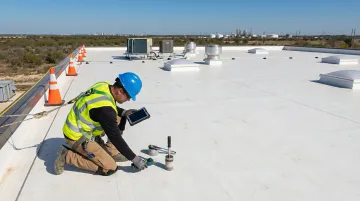
| Semi-annually (spring and fall) | Professional inspection of seams, flashings, drains, coating condition, and penetration seals | Aligned with storm season prep and post-season assessment |
| Annually | Full written assessment with photos, fastener and corrosion check on metal roofs, drainage flow test, insulation moisture check | Comprehensive documentation for warranty compliance |
| Every 5–10 years (condition-based) | Coating reapplication evaluation; consult manufacturer warranty requirements | Depends on product and condition |
| Every 10–15 years | Major structural review and comprehensive system assessment | Typically coincides with warranty renewal decisions |
High-Usage Facility Considerations
Facilities with frequent rooftop equipment servicing, chemical exposure, or heavy HVAC loads should schedule additional inspections beyond calendar-based timing. Accelerated wear is common in these environments, and calendar-only scheduling often misses the signs.
Engineered Roofing Systems offers long-term maintenance programs tailored to industrial clients across Southeast Texas. These programs keep inspections on schedule even during high-demand operational periods.
Documentation Benefits
A documented maintenance program supports manufacturer warranty compliance and provides a clear record if insurance claims arise after storm damage. Without that documentation, warranty claims can be denied — even when the damage itself qualifies.
Frequently Asked Questions
How to maintain a commercial roof?
Commercial roof maintenance involves regular professional inspections (at least twice a year), keeping drains and gutters clear, checking and resealing flashing around penetrations, and applying protective coatings as needed. Any damage should be addressed promptly before it escalates into larger, more expensive problems.
How often should an industrial roof be inspected?
Industrial roofs should be professionally inspected at least twice a year (spring and fall), with additional checks after severe weather events. High-activity facilities with frequent equipment servicing or chemical exposure may benefit from quarterly assessments.
What causes corrosion on metal industrial roofs?
Corrosion on metal roofs is primarily caused by prolonged moisture exposure, particularly at seams, fasteners, and panel edges. In Southeast Texas, high humidity and heat accelerate oxidation, while chemical or industrial fumes near the roofline and coastal salt spray can further speed up rust development.
Can roof coatings prevent leaks and corrosion on industrial roofs?
Elastomeric and reflective roof coatings form a seamless, waterproof barrier over the existing surface, sealing small cracks and blocking moisture from reaching the metal substrate. They also reduce heat absorption and UV degradation, extending the roof's service life by 10–20 years when properly applied and maintained.
What are the most common signs that an industrial roof is failing?
Key warning signs include interior water stains, visible rust or membrane blistering on the exterior, pooling water that doesn't drain within 48 hours, and recurring leaks in the same area despite prior repairs. Sagging sections or sudden increases in cooling costs also indicate serious problems.
When does an industrial roof need to be replaced vs. repaired?
Repair is appropriate when damage is localized — failed flashing, a cracked seal, or a small membrane breach. Replacement or re-roofing becomes necessary when there's widespread membrane failure, structural deck damage, or active corrosion across a significant portion of the roof surface.