Introduction
Picture this: A storm rolls through Southeast Texas overnight. By morning, water is dripping through the ceiling of your warehouse, production lines are halted, and your team is scrambling to contain the damage. The culprit? A small seam separation that went unnoticed for months.
This scenario plays out across commercial and industrial facilities more often than it should—and it highlights the core tension every facility manager faces: acting fast when something fails versus acting early before it does. Studies consistently show that reactive emergency repairs cost 3–5 times more than the same work done under a planned maintenance program. For commercial and industrial buildings, that gap adds up fast.
The approach you take—emergency repairs when things break or scheduled maintenance before they do—directly affects your costs, your operations, and how long your roof lasts. In Southeast Texas, where hurricane season, heavy rainfall, and brutal UV exposure put roofs under constant stress, the stakes are higher than most regions. This guide breaks down both approaches, compares the real costs, and helps you decide which strategy fits your facility.
Key Takeaways
- Emergency roof repair addresses immediate threats like active leaks or storm damage that cannot wait
- Planned maintenance involves scheduled inspections and preventive care to catch problems before they escalate
- Emergency repairs typically cost 3-5 times more than proactive fixes due to premium labor and secondary damage
- Planned maintenance can extend roof lifespan by 10–15 years and preserves manufacturer warranties
- A maintenance-first strategy is the single most effective way to reduce emergency repairs and control long-term roofing costs
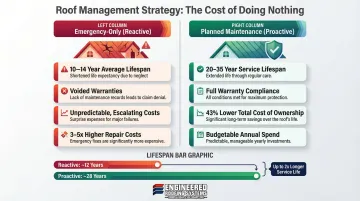
Emergency Roof Repair vs. Planned Maintenance: Quick Comparison
Here's how the two approaches stack up across the factors that matter most to facility managers and building owners.
Cost
Emergency Roof Repair:
- Higher per-incident cost—unpredictable and often addresses only symptoms
- Premium labor rates (25-50% markup for after-hours work)
- Rush material sourcing adds $300-$1,500 in urgency fees
- Reactive maintenance costs 3-5 times more than proactive programs
- May require follow-up repairs if root cause isn't addressed
Planned Maintenance:
- Lower per-visit cost—averages $0.04-$0.14 per square foot annually
- Fully budgetable with predictable annual expenditures
- Reduces total cost of ownership by 43% over a 24-year lifecycle
- Significantly lowers the risk of major failures before they happen
Business Disruption
Emergency Roof Repair:
- Leaks halt production lines without warning
- Water intrusion damages inventory and equipment
- May trigger safety shutdowns
- Affects employees, tenants, and operations
- Unplanned downtime costs facilities an average of $25,000 per hour
Planned Maintenance:
- Work is coordinated in advance to minimize downtime
- Inspections and minor repairs rarely require facility shutdowns
- Operations continue with minimal interruption
- Schedule inspections around your operational hours
Roof Lifespan & Warranty
Emergency Roof Repair:
- Repeated reactive repairs accelerate membrane wear
- May void manufacturer warranties if unauthorized repairs are made
- Shortens overall roof life significantly
- Reactive approach yields 10-14 year average lifespan
Planned Maintenance:
- Extends roof life from 10-14 years to 20-35 years
- Required by most manufacturer warranty programs
- Documented maintenance proves proper care
- Protects your warranty investment
What Is Emergency Roof Repair?
Emergency roof repair is any unplanned, immediate intervention required when roof damage poses an active threat to your building's interior, structure, or occupant safety. Unlike standard repair work that can be scheduled within days or weeks, emergencies demand immediate response.
Common Emergency Scenarios in Commercial and Industrial Buildings
True roofing emergencies in Southeast Texas typically include:
- Active water intrusion causing leaks into facility spaces
- Severe storm damage exposing the roof deck or membrane
- Large-scale flashing separation compromising waterproofing
- Membrane punctures from fallen equipment or debris
- Ponding water actively infiltrating the building
Southeast Texas's climate makes these scenarios especially relevant. Hurricane Harvey dumped an estimated 19 trillion gallons of water on the region, while Hurricane Ike caused approximately $12.5 billion in insured damage.
During Harvey, 85% of all commercial property claims in Texas were concentrated in the Coastal Bend and Houston Area, with an average paid loss of $238,000 per commercial claim.
Not everything that looks urgent requires an emergency response. A new ceiling stain warrants a prompt inspection — active water intrusion near electrical systems or structural components demands action now.
- Call immediately: water is actively entering the building, or structural compromise is visible
- Schedule a prompt inspection: isolated stains, minor ponding, or cosmetic damage
The Hidden Costs of Emergency Repairs
Emergency work carries significant cost multipliers beyond the basic repair price:
Premium Pricing:
- After-hours labor rates add 25-50% to standard costs
- Expedited material sourcing adds $300-$1,500 in urgency fees
- Time pressure limits thoroughness of repairs
- Overall reactive maintenance costs 3-5 times more than proactive programs
Secondary Damage Cascade:
The real cost rarely stops at the roof. Water intrusion triggers a cascade of secondary damage:
- Interior damage to insulation, ceilings, and drywall
- HVAC unit and electrical system exposure
- Stored inventory and equipment damage
- Mold remediation requirements
- Business interruption claims
That secondary damage compounds quickly. Moisture accounts for 70-75% of all building defects, and eliminating water intrusion early prevents losses from amplifying by 30% or more.
Emergency repairs are also often temporary stabilization measures: tarping, patching, or sealant application rather than permanent fixes. Proper repairs follow once conditions allow — meaning you typically pay twice for the same problem.
What Is Planned Roof Maintenance?
Planned (proactive) roof maintenance is a systematic, scheduled program of inspections, preventive repairs, and documentation designed to identify and address small issues before they escalate. This is the standard approach for professionally managed commercial and industrial facilities.
What a Planned Maintenance Program Includes
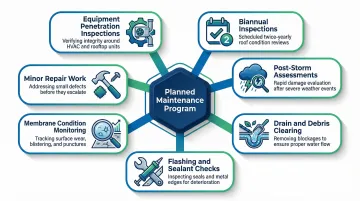
A comprehensive commercial maintenance program typically includes:
- Biannual inspections (spring and fall) to catch seasonal wear
- Post-storm assessments after significant weather events
- Drain and debris clearing to prevent ponding water
- Flashing and sealant checks at vulnerable penetration points
- Membrane condition monitoring for cracks, blisters, or separation
- Minor repair work performed as issues are identified
- Equipment penetration inspections for facilities with rooftop HVAC or solar
Roof Coatings as Preventive Maintenance:
Reflective or elastomeric coatings applied as part of a planned program can extend membrane life, reduce UV degradation, and lower cooling costs. Cool roofs can stay more than 50°F cooler than conventional roofs and reduce air-conditioning energy use by up to 50%.
For industrial clients across Southeast Texas, ASTEC fluid-applied coating systems — a core service at Engineered Roofing Systems — restore existing roofs without costly tear-offs and extend asset life by 10–20 years.
The Business Case for Planned Maintenance
Coating maintenance is only one piece of the financial argument. The broader case for proactive programs comes down to two fundamentals: budget control and warranty protection.
Budget Predictability
Planned maintenance converts unexpected emergency costs into manageable operational budgets. For facility managers overseeing multiple buildings or complex industrial sites, this predictability is critical for annual budget planning and avoiding surprise capital approvals.
Warranty Compliance
Most manufacturer warranties explicitly require documented maintenance at specified intervals. Carlisle, Versico, and Duro-Last all require inspections every six months and prompt leak notification within 7–30 days.
Missed inspections or unauthorized repairs can void coverage — potentially leaving you responsible for full replacement costs.
Best Candidates for Maintenance-First Strategies:
Facilities that benefit most from proactive maintenance include:
- Aging roofs (10+ years old)
- Buildings with rooftop solar panels or mechanical equipment
- Manufacturing plants and warehouses where production continuity is critical
- Multi-building campuses managing phased capital planning
Emergency Repair vs. Planned Maintenance: Which Approach Is Right for You?
Evaluate Your Current Situation
Consider these factors to determine whether you're operating in reactive or proactive mode:
- When was your roof last professionally inspected?
- How frequently have you called for repairs in the past year?
- Do you have documented maintenance records?
- What is the age of your current roof system?
Situational Decision Guide
Choose immediate emergency repair when:
- Active water intrusion is occurring
- Visible structural compromise exists
- Storm damage leaves the roof open to the elements
- Water threatens electrical systems or critical equipment
Choose planned maintenance when:
- The roof is intact but aging
- Minor wear is visible but not critical
- No inspection has been done in the past 12 months
- You want to extend roof life and avoid emergencies
Those decision criteria matter because most roof failures are preventable. Research shows that 50% of building defects appear within the first five years, and 75% of roof performance issues stem from factors other than natural degradation. Installation errors and neglected maintenance — not age — are the primary culprits.
The False Economy of Emergency-Only Strategies
Relying solely on emergency repairs without a maintenance framework leads to compounding damage, shortened roof life, and eventual full replacement far earlier than necessary. Unmaintained roofs last 10-14 years, while proactively managed roofs last 20-35 years. That's a gap of 10-20 years of service life — and the replacement cost that comes with it.
The Bridge Scenario: Transitioning to Proactive Care
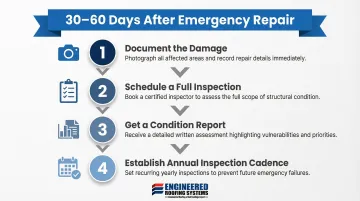
When emergency repair is necessary, it should trigger—not replace—the start of a planned maintenance program. In the 30-60 days following an emergency repair:
- Document the damage with photos and detailed notes
- Schedule a full inspection to assess overall roof condition
- Get a condition report outlining current issues and projected lifespan
- Establish an annual inspection cadence with a qualified contractor
Condition reports from post-emergency inspections frequently reveal secondary issues that weren't visible during the initial repair — catching them early is far less costly than waiting for the next failure.
Real-World Application: How Commercial Facilities Benefit from Maintenance-First Strategies
Case Study: Comcast Multi-Facility Management
Engineered Roofing Systems has managed roofing for 33 Comcast facilities across Southeast Texas since 2012. The program ran in two phases: ERS maintained the original roofs through the early years, then completed full reroofing projects in 2017 and again in 2022 — each on a planned, budgeted schedule rather than as a crisis response.
Chronic leaks were disrupting operations and threatening equipment across the portfolio when ERS took over. Between major reroofing cycles, the maintenance program included:
- Annual inspections to track system condition across all 33 sites
- Leak detection and targeted repairs before failures escalated
- Roof condition evaluations to time and budget capital projects accurately
- Preventative protocols that caught minor issues before they became emergencies
The results across the multi-year program:
- Emergency repair costs dropped through consistent early detection
- Roof service life extended between each capital project
- Operations continued without unplanned shutdowns at any facility
- Capital budgets became predictable rather than reactive
Metrics That Matter
For commercial and industrial decision-makers, the key performance indicators include:
- Years of extended service life: 8-21 additional years with proactive management
- Reduction in emergency calls: Measurable drop in unplanned service calls across maintained facilities
- Cost comparison: 43% savings in total cost of ownership over 24 years
- Operational continuity: Minimal unplanned downtime
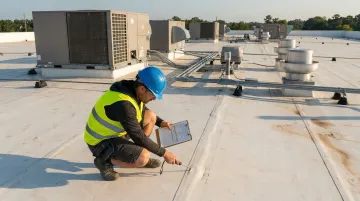
Facilities that shift from reactive repairs to a structured program — even starting with one comprehensive inspection — typically see measurable reductions in both emergency costs and total roofing spend within five years. The Comcast portfolio is one example; the pattern holds across commercial and industrial facilities of every size.
If your commercial or industrial facility in Southeast Texas hasn't had a professional roof inspection in the past year, Engineered Roofing Systems can help you assess current condition and build a maintenance plan that keeps your operations running and your roof protected. Call us to schedule an assessment.
Conclusion
Emergency repairs will always have a place—storms happen, equipment fails, unexpected events occur—but they should be the exception, not your operating model. For commercial and industrial facilities, planned maintenance is consistently the more cost-effective, less disruptive, and longer-lasting strategy.
The smarter path is to treat emergency repairs as a stopgap, then transition to a maintenance-first approach as quickly as operations allow. Facilities that invest in regular inspections and proactive care protect their roof, their operational continuity, and their long-term operating costs—especially in a climate as demanding as Southeast Texas.
Frequently Asked Questions
What constitutes an emergency roof repair?
An emergency roof repair is required when damage poses an immediate threat to the building's interior, structure, or occupant safety — specifically: active water intrusion, exposed roof deck after storm damage, large membrane failures, or visible structural compromise. Damage that can be safely scheduled within days or weeks falls outside that category.
How often should a commercial roof be inspected as part of planned maintenance?
Most commercial roofing professionals recommend at minimum two inspections per year—typically in spring and fall—plus a post-storm assessment after any significant weather event. Facilities with aging roofs, rooftop equipment, or complex systems may benefit from quarterly monitoring.
Can planned maintenance prevent all roofing emergencies?
Planned maintenance reduces the likelihood and severity of roofing emergencies, but it can't prevent every scenario — severe storms and sudden equipment failures still happen. A well-maintained roof holds up far better when they do.
How much more expensive is emergency roof repair compared to planned maintenance?
Emergency repairs cost 3-5 times more per square foot than equivalent planned repairs, driven by premium labor rates, expedited materials, and urgency fees. Secondary damage costs—interior repairs, mold remediation, operational disruption—often dwarf the repair cost itself.
Does skipping roof maintenance void my manufacturer's warranty?
Yes. Most manufacturer warranty programs for commercial roofing systems require documented maintenance at specified intervals (typically every 6 months). Failure to maintain inspection records or allowing unqualified repairs can void coverage, potentially leaving facility owners responsible for full replacement costs.
What should I do immediately after discovering a leak in my commercial facility?
Start by protecting interior assets — move equipment, place containment, and photograph all visible damage. Then call a licensed commercial roofing contractor for an emergency assessment. Follow any temporary stabilization with a full inspection and permanent repair as soon as conditions allow.