Introduction
Commercial roofs in Southeast Texas face relentless exposure to hail, high winds, hurricanes, and flash flooding. Even well-maintained roofing systems take a hit, and the window for action is narrow. The NRCA warns that ponding water still present 48 hours after rain signals a drainage deficiency that accelerates membrane failure.
The EPA, CDC, and FEMA all note that mold colonies can begin forming within 24 to 48 hours of water intrusion. A manageable leak ignored for a day can become a costly remediation project.
Knowing how to respond quickly makes the difference. This guide covers the most common types of storm damage on commercial roofs, a step-by-step assessment and repair process, when to repair versus replace, and how to prevent future damage.
Key Takeaways
- Wind uplift, hail punctures, membrane tears, and flashing displacement are the most common storm damage types on commercial roofs
- Document damage immediately, apply temporary protection, and schedule a professional inspection within 48–72 hours
- Whether to repair or replace depends on roof age, damage extent, and whether the underlying structure is compromised
- Leaving storm damage unaddressed causes leaks, mold growth, voided warranties, and significantly shortened roof life
- Professional moisture scanning detects hidden insulation damage that visual inspections miss
Types of Storm Damage on Commercial Roofs
Commercial roofs face multiple types of storm damage simultaneously. Low-slope and flat roofs common in commercial buildings are especially vulnerable because water does not shed naturally, creating conditions for accelerated deterioration.
Wind Damage
Wind uplift forces separate roofing membranes at seams and edges—especially on flat roofs—while also displacing flashing and loosening fasteners. Damage is often invisible until the next rainstorm reveals leaks. Perimeter edges and roof corners experience the highest uplift pressures during storms, making them the most vulnerable zones.
Hail Impact
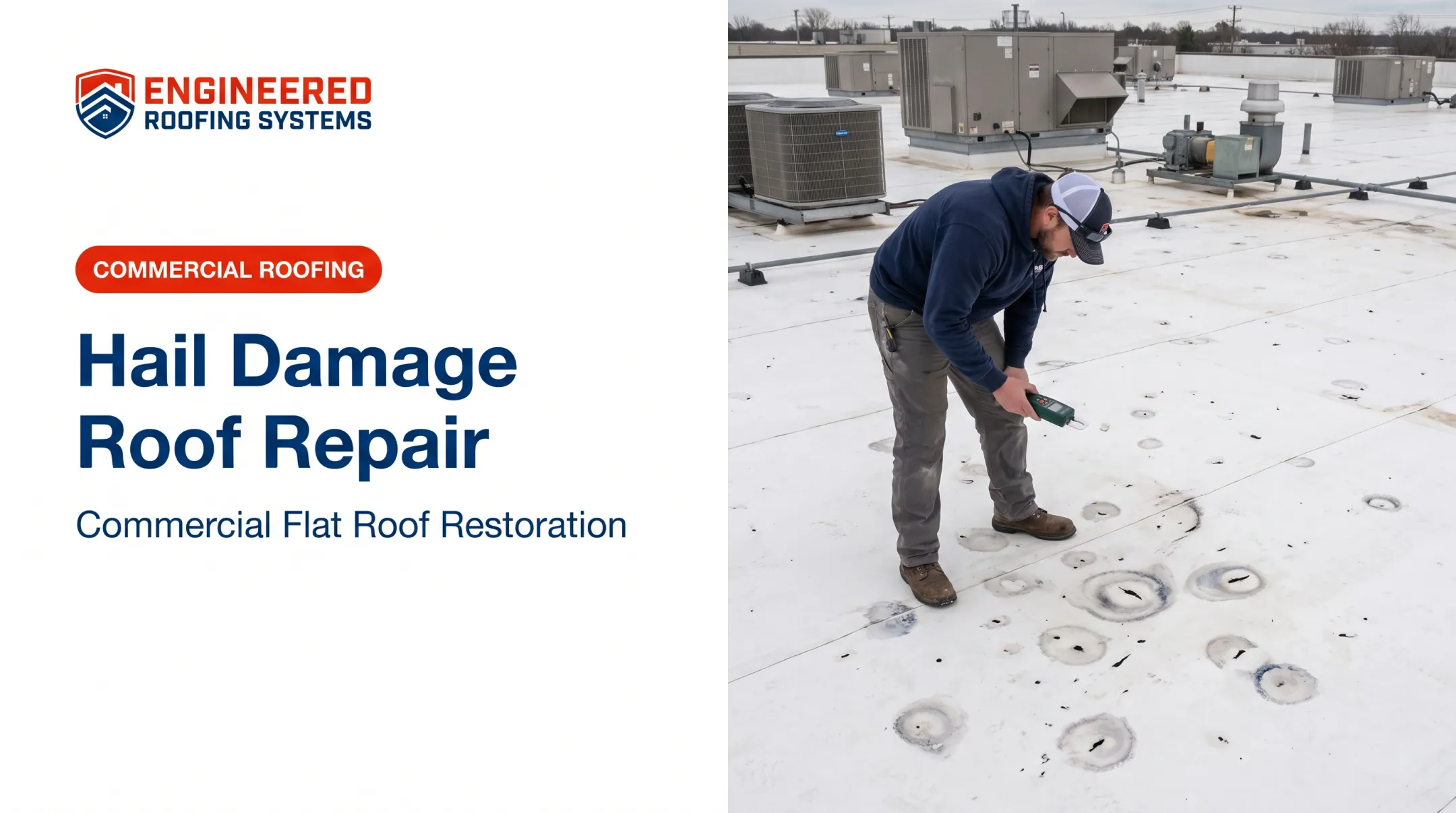
Hailstones can puncture single-ply membranes (TPO, PVC, EPDM), dent metal panels, and crack modified bitumen surfaces. Even sub-1-inch hail can cause hidden damage that shortens roof life. Visible denting may or may not be covered depending on your policy terms.
Many commercial property owners don't discover hail damage until leaks develop weeks or months later.
Water Infiltration and Ponding
Heavy rainfall exploits pre-existing vulnerabilities—open seams, blocked drains, low spots—and standing water (ponding) accelerates membrane breakdown, insulation damage, and deck deterioration. Mold growth can begin within 24–48 hours of water intrusion, creating health hazards and requiring expensive remediation.
Debris Impact and Structural Damage
Wind-carried debris such as tree branches, signage, or HVAC components can puncture roofing materials or damage rooftop equipment. Structural damage to the roof deck below is the most serious and costliest outcome, often requiring complete section replacement rather than surface repairs.
How to Assess Storm Damage on a Commercial Roof: Step-by-Step
Attempting repairs without a thorough, documented assessment wastes time and money—and can result in missed damage that invalidates insurance claims or warranties.
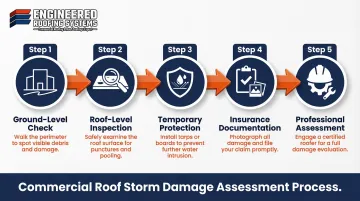
Step 1: Conduct a Preliminary Ground-Level and Interior Check
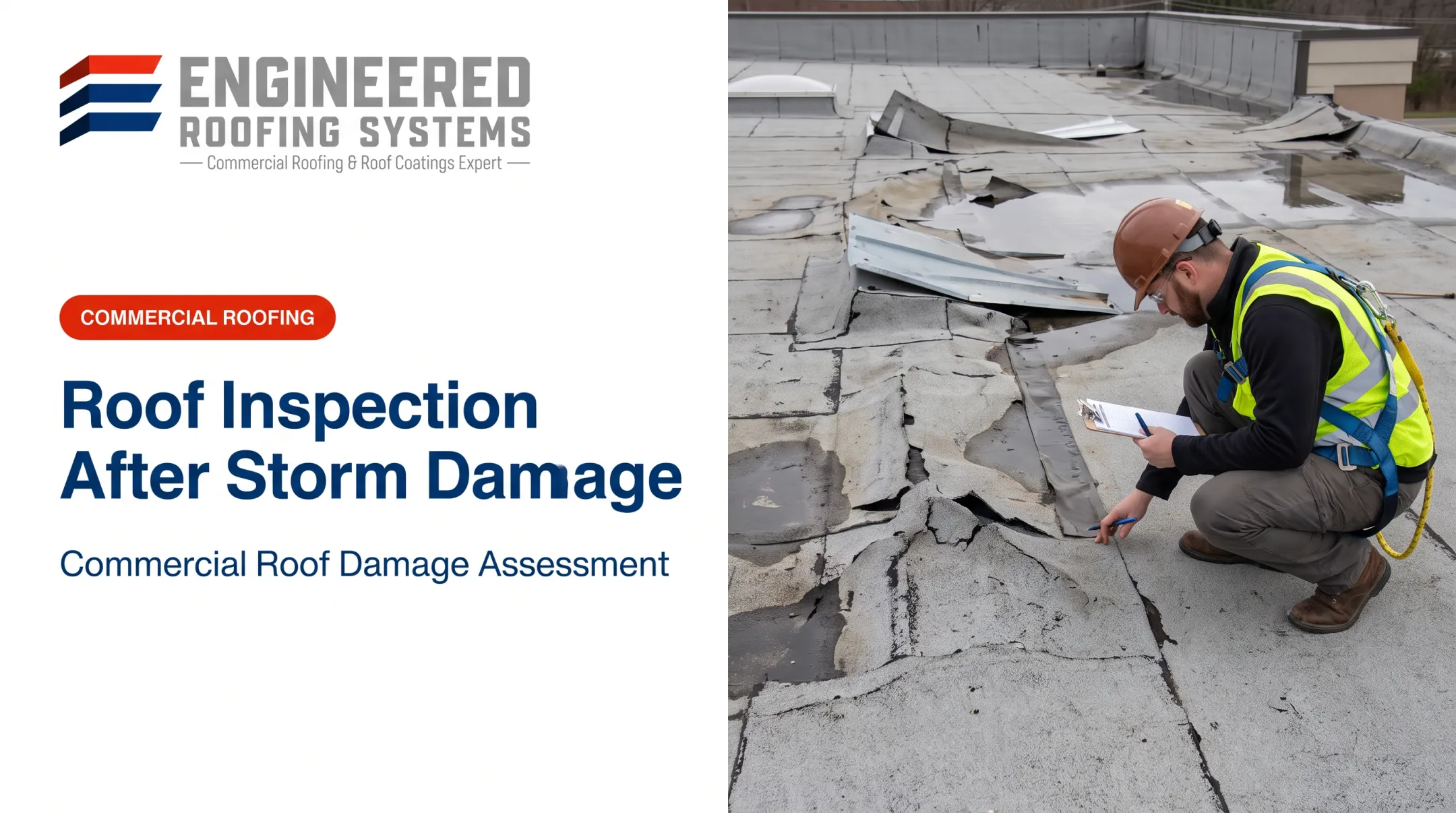
Walk the building perimeter looking for displaced materials, debris, or damaged gutters and downspouts. Inspect interior ceilings and walls for water stains, dripping, or discoloration. Interior leaks often don't surface for days after a storm. Repeat interior checks over at least 72 hours before assuming the building is dry.
Step 2: Perform a Documented Roof-Level Inspection
Safely access the roof to inspect:
- Membrane surfaces for punctures, tears, or blistering
- Seams for separation or lifting
- Flashing at walls, curbs, and penetrations
- Rooftop equipment (HVAC units, vents, skylights)
- Drainage points for blockages
Photograph and timestamp every area of concern. Use moisture meters or infrared scanning where available to locate hidden wet insulation beneath the membrane—damage that standard visual checks will miss.
Step 3: Prioritize Temporary Protection
Ensure temporary protection is in place over punctures, open seams, and displaced flashing before any permanent repair work begins. Every hour of delay allows water to migrate deeper into the building assembly, escalating costs. It can also trigger the "duty to mitigate" clause in commercial insurance policies, which may reduce your covered claim if you failed to act promptly.
Step 4: Document Everything for Insurance
Compile a complete damage report with dated photos, moisture readings, and a written description of damage per roof zone. Commercial insurance adjusters typically expect:
- Photo timestamps showing date and time
- Coverage area references (e.g., "northeast corner, 20 feet from parapet")
- Notes distinguishing pre-existing versus storm-caused damage
- Moisture readings documenting wet insulation
Getting a professional inspection on record within 48–72 hours of the storm strengthens your claim before an adjuster arrives.
Step 5: Obtain a Professional Assessment Before Committing to a Repair Scope
Owner documentation alone rarely satisfies commercial insurance adjusters. A licensed contractor's written inspection report carries more authority—and catches damage that visual walkthroughs miss. A thorough contractor assessment typically includes:
- Infrared or thermal imaging to detect subsurface moisture that may require insulation replacement
- Written documentation formatted for insurance adjuster review
- Warranty impact analysis, since certified contractors for manufacturers like Versico, Carlisle, or Duro-Last can identify damage patterns that affect coverage eligibility
How to Repair Storm Damage by Damage Type
The right repair method depends entirely on the roofing system material, the extent of damage, and whether the underlying deck and insulation are intact. Applying the wrong fix—such as patching over wet insulation—will cause the problem to recur. The right repair method depends entirely on the roofing system material, the extent of damage, and whether the underlying deck and insulation are intact. Applying the wrong fix—such as patching over wet insulation—will cause the problem to recur. The subsections below break down repairs by damage type and roofing system.
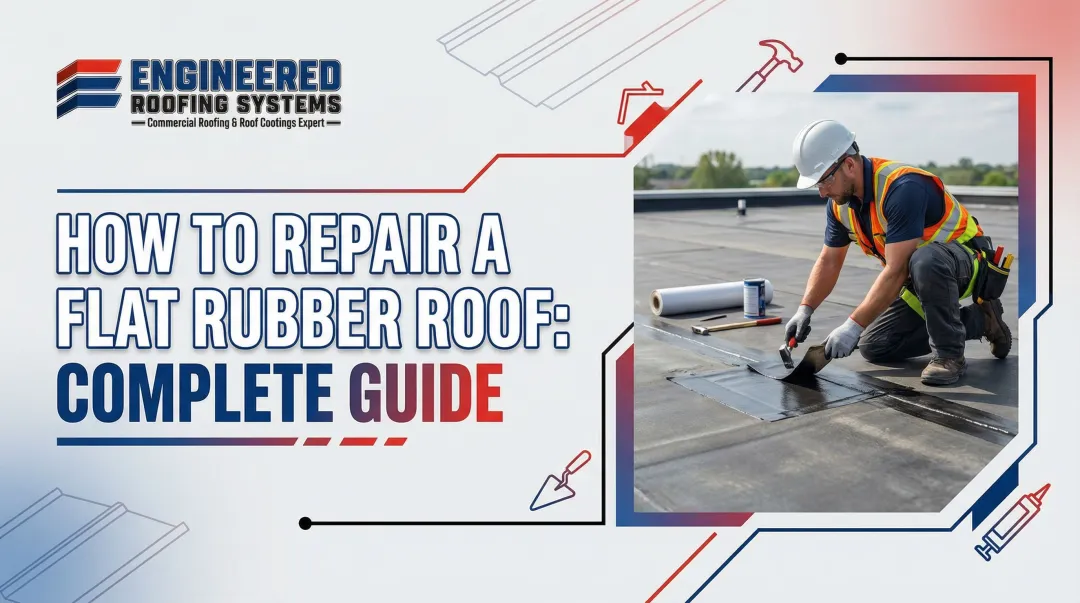
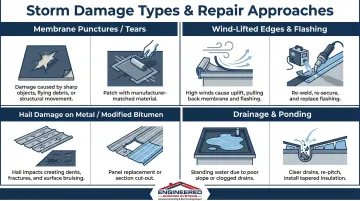
Repairing Membrane Punctures and Tears (TPO, PVC, EPDM)
The process:
- Clean and dry the damaged area thoroughly
- Cut a compatible patch material matching membrane type and manufacturer
- Apply heat-welded or adhesive bonding per manufacturer specifications
- Inspect seams with a probing tool to verify bond integrity
Using mismatched patch materials voids manufacturer warranties. Certified contractors use manufacturer-approved materials to preserve warranty coverage. For example, TPO patches must be heat-welded at specific temperatures; PVC requires solvent-based adhesives; EPDM uses tape or liquid adhesives.
Repairing Wind-Lifted Edges, Seams, and Flashing
Each component requires a specific approach:
- Re-adhere or re-weld lifted membrane sections using the same bonding method as the original installation
- Re-secure perimeter metal edging with additional fasteners where separation has occurred
- Replace displaced or corroded flashing at walls, curbs, and penetrations
Improperly re-secured flashing is one of the most common sources of recurring leaks after storm repairs.
Addressing Hail Damage on Metal and Modified Bitumen Roofs
For metal roofing, assess whether denting has compromised the panel's water-shedding function or is cosmetic only. Replace panels with structural cracks or open seams. Insurance coverage for dented metal varies by carrier—some policies exclude cosmetic denting that doesn't cause leaks.
For modified bitumen, cut out and replace compromised sections. Apply compatible reinforced patching using torch-applied or cold-adhesive methods depending on the original system.
Repairing Drainage Systems and Preventing Ponding
Start with the basics:
- Clear clogged internal drains, scuppers, and gutters
- Repair damaged downspouts
- Re-pitch low spots where possible
FM Global warns that chronic ponding creates a "ponding cycle" where deck deflection holds more water, increasing deflection further until collapse occurs. Chronic ponding may require a tapered insulation system or drain relocation—solutions a roofing professional should scope.
Applying Roof Coatings for Damaged or Aging Surfaces
For roofs with widespread surface degradation—cracked surfaces, minor widespread seam separation, UV erosion—that stop short of requiring full replacement, a professional-grade elastomeric or silicone roof coating can reseal the entire surface, extend roof life, and improve energy efficiency. Engineered Roofing Systems is an authorized ASTEC dealer and Versico Gold Medal Contractor, applying manufacturer-backed coatings across Southeast Texas. For many commercial properties, this approach adds years of service life without the cost of a full replacement.
When to Repair vs. Replace Your Commercial Roof After Storm Damage
Three factors drive this decision: the depth and extent of damage (surface only vs. deck or structure), the roof's remaining service life, and what repairs will cost relative to a full replacement.
Repair When:
- Damage is isolated to specific zones (less than 25% of total roof area)
- The underlying deck and insulation are dry and structurally sound
- The roof is fewer than 10–15 years into its expected lifespan
- Repair costs are substantially lower than replacement (typically less than 30% of replacement cost)
Replace (or Re-Roof) When:
- Damage affects large portions of the roof surface or has saturated insulation and compromised the deck
- The roof is at or near the end of its service life and repeated repairs are escalating costs
- A licensed contractor's inspection confirms the existing system can no longer be reliably restored to a watertight condition
- Re-roofing with a quality membrane or coating system opens the door to manufacturer warranties of up to 30 years — resetting your protection timeline rather than extending a compromised one
The Gray Zone: What to Do When You're Unsure
Get a second opinion from a certified commercial roofing contractor. A moisture scan is often what settles the question — widespread wet insulation can signal deck damage even when the surface looks minor. From there, ask for:
- Infrared or nuclear moisture readings mapped across the roof
- Photographs documenting all damage zones
- A written cost comparison of repair vs. replacement
- An honest assessment of how much service life a repair actually buys
Early action on borderline cases costs less than waiting for the next storm to make the decision for you.
Preventing Future Storm Damage on Commercial Roofs
Most storm damage is not fully preventable, but its severity is directly tied to the condition of the roof before the storm—a well-maintained roof withstands weather significantly better than a neglected one.
Schedule Biannual Professional Inspections
Professional roof inspections twice per year — spring and fall — plus a check after any significant weather event will catch failing seams, blocked drains, or lifting flashing before they become storm-season catastrophes. Addressing these at inspection cost is a fraction of post-storm repair bills. Regular maintenance also extends a roof's typical lifespan, often by 5-10 years.
Reinforce Vulnerable Areas and Upgrade Materials Where Needed
Perimeter edges, penetrations, and seams are the highest-risk failure points in a storm. Targeted upgrades include:
- Additional fasteners at perimeter edges
- Improved perimeter edging systems
- Seamless coatings over aging membranes
- Upgraded flashing at penetrations
In Texas, investing in membranes with verified wind uplift ratings and impact resistance is particularly important given the frequency of Gulf storms and hail events.
Common Mistakes That Accelerate Damage
- Delaying post-storm inspection: Waiting weeks allows hidden damage to worsen
- Using incompatible patch materials: Voids warranties and causes premature failure
- Skipping post-repair testing: Leaves watertight integrity unverified
- Failing to clear drainage systems before storm season: Guarantees ponding and water infiltration
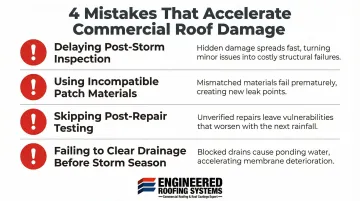
Avoiding these mistakes is where prevention pays off most — the cost of doing it right the first time is almost always less than fixing a repeat failure.
Frequently Asked Questions
What is considered storm damage to a roof?
Storm damage includes any weather-caused damage to the roof's ability to repel water or maintain structural integrity—wind uplift, hail punctures, debris impacts, flashing displacement, and membrane tears all qualify. Cosmetic damage (like minor denting with no water infiltration) may be treated differently by insurers.
Does commercial insurance cover roof leaks?
Most commercial property policies cover storm-related leaks but exclude damage from gradual deterioration or deferred maintenance. Check your policy for storm-specific terms, deductibles, and pre-existing condition exclusions.
Who is responsible for roof repairs in a commercial lease?
Responsibility depends on the lease structure: gross and modified gross leases typically place repair costs on the landlord, while triple-net (NNN) leases may assign them to the tenant. Review your lease carefully and consult legal counsel if responsibility is disputed.
Is replacing a roof on a commercial building tax deductible?
Roof repairs are generally deductible as a business operating expense in the year incurred, while a full replacement typically needs to be capitalized and depreciated over time. A tax professional can clarify which treatment applies to your situation.
How soon after a storm should I get my commercial roof inspected?
Schedule a professional inspection within 48–72 hours of the storm. Prompt documentation strengthens insurance claims, prevents secondary damage from progressing, and captures damage patterns before they become harder to attribute to the storm.