Introduction
A small failure in roof flashing — the thin metal barrier sealing vulnerable points around vents, HVAC units, skylights, parapet walls, and drainage edges — can cascade into serious water intrusion damage. On a commercial roof, that means structural deterioration, mold, and disrupted operations.
The real cost issue isn't the flashing itself. It's the timing of the call. Facility managers who wait too long face structural damage, mold, and disrupted operations. Those who reach for a DIY patch too quickly often void manufacturer warranties or miss the underlying cause entirely.
This article outlines the specific warning signs and conditions that tell you it's time to call a licensed professional — before a manageable repair becomes a full roof replacement.
Key Takeaways
- Roof flashing failure is one of the leading causes of commercial roof leaks — often unnoticed until interior damage appears
- Visible rust, lifting metal, water stains, and recurring leaks signal the need to call a professional immediately
- DIY repairs on commercial flashing can void manufacturer warranties and violate building codes
- Southeast Texas heat, humidity, and storms accelerate flashing deterioration faster than in drier climates
- Calling a pro at the first sign of failure is the most cost-effective move — waiting until water is coming in will cost significantly more
Why the Timing of Calling a Pro Matters for Roof Flashing
Flashing damage is progressive. A small crack or lifted edge allows moisture in, which then deteriorates the substrate, insulation, and eventually interior finishes. The longer the gap between damage and professional repair, the more expensive the outcome.
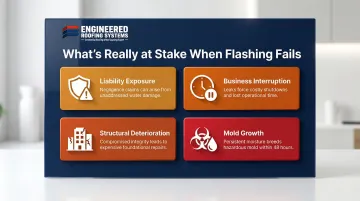
For commercial and industrial properties, those costs compound quickly. A compromised flat roof over a warehouse, manufacturing floor, or server room creates risks that go well beyond repair bills:
- Liability exposure from water-damaged equipment or inventory
- Business interruption if critical operations must pause
- Accelerated structural deterioration in metal decking and insulation
- Potential mold growth that triggers building health concerns
Early professional intervention is a business decision, not just a maintenance task.
Southeast Texas conditions push flashing to failure faster than most climates. High humidity, extreme heat causing metal expansion and contraction, and a long Gulf Coast storm season are a damaging combination for commercial buildings.
According to OSHA guidance on building moisture control, roof leaks are a primary vector for moisture intrusion leading to building-related illnesses — and damp materials must be dried within 24 to 48 hours to prevent mold growth. Once water enters through failed flashing, the clock starts immediately.
Warning Signs You Need to Call a Professional for Flashing Repair
Any of the following signs indicates flashing failure that goes beyond a DIY fix. For facility managers and building owners in Southeast Texas, catching these early limits the damage — and the cost.
Visible Corrosion, Rust, or Deterioration on the Flashing Metal
Rust on steel flashing or pitting on aluminum flashing signals that the protective barrier is compromised. Any corrosion indicates the metal has lost its ability to repel water at the joint. In high-humidity environments like Houston or coastal Texas, corrosion spreads rapidly once it begins.
What to look for:
- Orange or brown rust spots on steel flashing
- White powdery residue or pitting on aluminum
- Flaking or peeling protective coatings
- Visible holes or thin spots in the metal
Flashing That Is Lifting, Separating, or Pulling Away from the Surface
Flashing visibly pulling away from a parapet wall, chimney, skylight curb, or HVAC penetration creates an open channel for water. This is often caused by wind uplift, thermal expansion, or failed sealant — and cannot be addressed with a caulk gun alone. The underlying attachment must be professionally assessed and re-secured.
Active Leaks or Water Intrusion Following Rain Events
If water appears inside a building during or after rainfall and the source traces back to a roof penetration, treat it as a professional-level emergency. Water entry near electrical systems or in facilities with sensitive inventory requires immediate action.
High-risk locations to check:
- Interior walls and ceiling tiles near rooftop equipment
- Light fixtures and conduit runs below penetrations
- Loading dock ceilings and warehouse perimeter walls
- Areas below previously patched penetrations
Interior Water Stains, Mold, or Mildew Odor in Ceiling or Wall Areas
By the time staining or mold is visible indoors, water has already traveled through multiple roof layers. This indicates a flashing failure that has likely been ongoing for weeks or months. A professional inspection is needed not just to repair flashing, but to assess whether decking, insulation, or structural components have been compromised.
OSHA compliance note: Federal workplace safety regulations require employers to maintain workplaces free from recognized hazards. Visible mold from roof leaks can trigger General Duty Clause violations.
Indoor air quality results showing hazardous microbial levels become employee exposure records — requiring 30-year retention under 29 CFR 1910.1020.
Recurring Leaks in the Same Location After Previous Patch Repairs
Repeated leaks in the same area — even after prior sealant or caulk applications — indicate that the surface fix is not addressing the actual failure point. Professionals use diagnostic methods like infrared scanning or flood testing to trace water migration paths, which often originate several feet from where the leak appears indoors.
Situations Where DIY Is Not an Option — Call a Pro
While simple caulk touch-ups on non-critical areas may seem manageable, there are specific scenarios where attempting DIY flashing repair on a commercial building creates more risk than it resolves.
After a Storm, High Winds, or Hail Event
Storm-related flashing damage often involves displaced fasteners, lifted sections, and compromised sealant across multiple zones simultaneously. Insurance claims for storm damage require professional documentation and licensed contractor involvement. DIY repairs made before a professional assessment can complicate or invalidate an insurance claim.
Around Complex Commercial Roof Penetrations
Commercial roofs contain far more penetration points than residential roofs:
- HVAC curbs
- Exhaust stacks
- Plumbing vents
- Electrical conduits
- Rooftop access hatches
Each requires specific flashing methods and compatible materials. Improper DIY work at these intersections can void manufacturer warranties and create new leak pathways. Engineered Roofing Systems' team specializes in flashing repairs around complex industrial penetrations across facilities in Houston, Conroe, and the greater Southeast Texas region.
When the Roof Is Still Under a Manufacturer Warranty
Most commercial roofing manufacturer warranties — including those from Versico, Carlisle, and Duro-Last — contain explicit clauses that void coverage if repairs are made by uncertified or unlicensed contractors. Any DIY intervention on a warranted roof system must be avoided entirely. The financial exposure from a voided warranty far exceeds the cost of a professional repair call.
When Structural or Decking Damage Is Suspected
If flashing failure has allowed water intrusion over an extended period, the roof deck beneath may be soft, rotted, or structurally weakened. This condition cannot be safely assessed or repaired without professional tools and expertise. Re-securing flashing to compromised decking only masks the problem while the structural damage continues to worsen beneath.
When the Facility Operates Sensitive or High-Value Functions
For manufacturing plants, warehouses, data centers, and facilities with industrial equipment, water intrusion from failed flashing puts operations at risk — not just the building envelope. Inventory damage, equipment failure, and unplanned downtime all follow from a leak that wasn't addressed promptly.
Facility managers should call a professional at the first confirmed sign of flashing failure. A brief inspection now is far less costly than an emergency repair after the damage spreads.
What Happens When Flashing Repairs Are Delayed Too Long
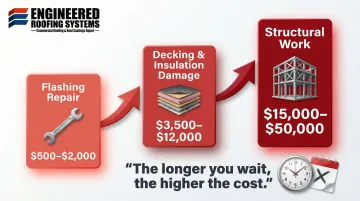
The damage cascade follows a predictable pattern:
- Water entering through failed flashing first saturates insulation, reducing thermal effectiveness and adding weight to the roof structure.
- Moisture then reaches the roof decking, causing rot or delamination in wood substrates and corrosion in metal decking.
- Left unaddressed, water reaches structural framing members, directly compromising load-bearing capacity.
At each stage, the repair scope and cost increase significantly. What starts as a $500-$2,000 flashing repair can escalate to $15,000-$50,000 in structural work if left unaddressed.
Cost isn't the only risk that compounds. Wet insulation and decking in a sealed commercial roof cavity create ideal mold growth conditions. In occupied facilities, mold exposure creates OSHA-related liability and health concerns that can trigger inspections, shutdowns, or legal exposure.
OSHA notes that while no Permissible Exposure Limits exist for airborne mold, employers remain liable under the General Duty Clause for failing to abate recognized hazards.
Delayed repairs carry a compliance risk as well. In Texas, moisture damage discovered during routine facility assessments can trigger mandatory inspections or local building code violations — converting a straightforward repair into a regulatory event with its own timeline and costs.
What to Expect from a Professional Flashing Inspection and Repair
The Inspection Process
A licensed contractor will conduct a systematic assessment:
- Walk the full roof perimeter and all penetration zones
- Check for lifted or separated metal
- Test sealant integrity
- Look for rust or corrosion
- Assess drainage patterns
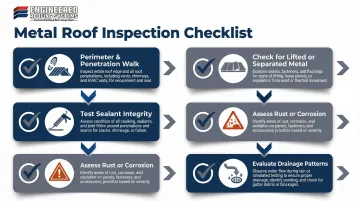
The goal is a comprehensive evaluation — not just a surface-level walkthrough. Engineered Roofing Systems includes scheduled flashing inspections as part of their long-term maintenance programs, helping commercial clients in Houston and Southeast Texas catch problems before they escalate.
Repair vs. Replace Decision
Minor issues (small sealant gaps, surface rust) may be resolved with:
- Cleaning and surface preparation
- Re-sealing with compatible materials
- Spot metal replacement in affected areas
Extensive deterioration — especially on older roofs or after storm damage — may require:
- Full flashing replacement in affected zones
- Substrate repair or replacement
- Membrane work around penetration areas
A professional will present a clear scope of work that outlines what needs immediate attention, what can be monitored, and what the estimated timeline and cost look like — so you can make an informed decision.
Timelines and Disruption
Flashing repairs on most commercial buildings can be completed without significant disruption to operations. Contractors typically coordinate around your schedule, with most repairs wrapped up in one to two days depending on scope. Common scheduling considerations include:
- Avoiding peak business hours or shift changes
- Planning roof access around active equipment or loading zones
- Sequencing work to keep interior operations running
- Completing emergency repairs as a priority before full restoration
If you're unsure what a repair involves or how long it will take, asking for a written timeline during the estimate stage sets clear expectations from the start.
Frequently Asked Questions
How much does it cost to repair flashing on a roof?
Minor repairs typically range from $500–$2,000, while full flashing replacement can reach $5,000–$15,000 depending on damage extent, material type, and roof location. An on-site assessment is the only reliable way to get an accurate estimate.
Does commercial property insurance cover flashing repair?
Coverage depends on the cause. Storm or wind damage is generally covered under commercial property policies, while gradual wear-and-tear deterioration is not. A qualified contractor can document the damage and support the claims process.
Can roof flashing be repaired without replacing the entire roof?
Yes, flashing can typically be repaired or replaced independently of the full roof system, especially when caught early. However, if flashing failure has caused widespread decking or membrane damage, a larger scope of work may be needed.
How long does roof flashing typically last on a commercial building?
Lifespan varies by material and climate. In Southeast Texas's heat and humidity, aluminum typically lasts 20–30 years, galvanized steel 15–25 years, and copper 50+ years. Routine inspections are the most effective way to get the full life out of any flashing material.
How do I know if a roof leak is caused by flashing failure versus other roofing issues?
Leaks near penetration points, roof edges, walls, or transitions are most commonly flashing-related. Leaks appearing mid-field on flat roofs may indicate membrane or seam issues. A professional inspection is the only reliable way to confirm the source, as water can travel several feet from its entry point before appearing indoors.
What types of flashing are most commonly found on commercial and industrial roofs?
Primary types include pipe boot/vent flashing (around plumbing penetrations), HVAC curb flashing (around rooftop units), parapet wall flashing (at vertical wall intersections), valley flashing (where roof planes meet), and edge/drip flashing (at roof perimeters). Each requires specific installation methods and materials suited to the roof system type.