Introduction
Industrial facility managers across Southeast Texas face a recurring challenge: metal roof corrosion is inevitable given the region's heat, humidity, and chemical exposure. Houston Hobby's climate data shows an average annual temperature of 70.2°F with record highs hitting 108°F, plus 54.65 inches of rainfall annually—conditions that accelerate metal deterioration. But visible rust doesn't automatically mean a full roof replacement is necessary.
The decision between corrosion treatment and full replacement is a high-stakes financial call. Treatment costs a fraction of replacement and keeps production lines running—but only when the roof's structural integrity remains intact.
Choose wrong, and you'll waste money on a patch that fails within months. Or you'll spend six figures tearing off a roof that had years of service left. This guide walks through exactly how to tell the difference.
Key Takeaways
- Corrosion treatment extends roof life 10–15 years at 30–50% the cost of replacement, provided structural integrity is sound
- Full replacement is the right call when structural damage or moisture saturation exceeds critical thresholds
- Key decision factors: corrosion depth, moisture saturation level, roof age, and tolerance for operational disruption
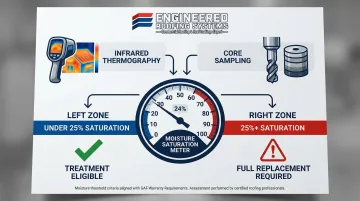
- The 25% rule: if moisture surveys show 25% or more of substrate is saturated, replacement is typically required
- Professional inspection with a moisture survey is mandatory; visual assessment alone misses hidden deterioration
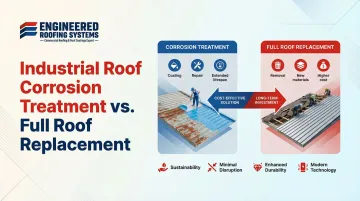
Corrosion Treatment vs. Full Roof Replacement: Quick Comparison
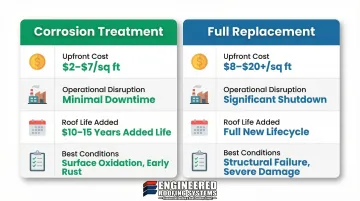
| Corrosion Treatment | Full Replacement | |
|---|---|---|
| Upfront Cost | $2–$7 per sq. ft. (varies by coating type, surface prep, and primer) | $8–$20+ per sq. ft. (includes tear-off labor, disposal, deck repairs, insulation, and reinstallation) |
| Operational Disruption | Applied over existing structure; production typically continues uninterrupted with no interior exposure | Complete tear-off exposes interior to weather; may require equipment relocation or partial shutdown |
| Roof Life Added | 10–15 years on a sound substrate; 20 mils dry film thickness typically yields 10 years, 30 mils up to 20 years | Full lifespan reset: standing seam metal (60+ yrs), EPDM (25–40 yrs), PVC (20–30+ yrs) |
| Best Conditions | Surface oxidation only, structurally intact deck, under 25% moisture saturation, resolvable leaks | Structural deck failure, through-metal corrosion, moisture saturation above 25%, persistent widespread leaks, or roof past rated service life |
What Is Industrial Roof Corrosion Treatment?
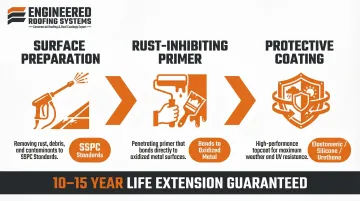
Industrial roof corrosion treatment is a multi-step restoration process for metal and low-slope roofs showing surface deterioration. The process works in three stages:
- Surface preparation: Power washing and removal of loose rust and debris
- Primer application: A rust-inhibiting primer that chemically bonds to oxidized metal
- Protective coating: A high-performance system in elastomeric, acrylic, silicone, or urethane formulations
Because the process is applied over the existing roof structure, facilities avoid the downtime of a full tear-off. For operations running continuous shifts—railcar repair shops, manufacturing plants, warehouses—even a partial shutdown translates directly to lost revenue.
Coating System Types and Applications
Different coating chemistries suit different environmental conditions:
Acrylic (Elastomeric): Best for UV-heavy climates, but not suitable where standing water pools. Water-based formulations meeting ASTM D6083 deliver excellent solar reflectance — Karnak 501 Elasto-Brite, for example, achieves 237% elongation and 259 PSI tensile strength.
Silicone: The right choice for low-slope roofs with drainage issues. Governed by ASTM D6694, silicone coatings withstand permanent ponding water without softening — a practical advantage for industrial facilities across Southeast Texas.
Polyurethane: Ideal for facilities exposed to industrial fumes or aggressive atmospheric conditions. ASTM D6947-governed polyurethane coatings provide superior tensile strength and chemical resistance where other chemistries fall short.
Energy Efficiency Benefits
High-reflectivity coatings reduce heat absorption significantly. Factory-coated metal roofs achieve Solar Reflectance Index (SRI) values ranging from 20-90 after three years of weathering. For large industrial buildings in Southeast Texas, this translates to measurably lower cooling costs—particularly valuable when treating 50,000+ square foot roof areas common in manufacturing and warehouse facilities.
Professional Application Standards
Proper corrosion treatment isn't a quick fix. Surface preparation follows SSPC standards based on corrosion severity:
- SSPC-SP2 (hand tool cleaning) — light rust
- SSPC-SP3 (power tool cleaning) — moderate oxidation
- SSPC-SP10 (near-white metal blast) — high-performance zinc-rich primer applications
Engineered Roofing Systems, an authorized ASTEC contractor and multi-year ASTEC Dealer of the Year, applies coating systems backed by manufacturer warranties of up to 30 years when these standards are met.
Use Cases of Corrosion Treatment
Ideal for industrial metal roofs showing:
- Surface oxidation and minor rust streaking where structural deck remains sound
- Early-stage corrosion in manufacturing plants, railcar repair facilities, and warehouses
- Facilities with limited downtime windows where operational continuity is priority
- Roofs with meaningful remaining service life (typically 5-10 years before end of rated lifespan)
When inspection confirms structural integrity is intact and operations can't absorb a full replacement project, corrosion treatment delivers the most value — and sets the stage for a longer-term maintenance plan.
What Is a Full Industrial Roof Replacement?
Full industrial roof replacement involves complete removal of the existing roofing system down to the structural deck, inspection and repair of the deck itself, and installation of an entirely new roofing assembly—including new insulation, membrane or metal panels, flashing, fasteners, and all accessories.
When Replacement Becomes Necessary
Replacement is the only viable path when:
- Corrosion has penetrated through the metal panels into the structural deck
- Moisture-saturated insulation covers 25% or more of the roof area
- Persistent leaks cannot be resolved through localized repairs
- The roof has reached or exceeded its rated service life
- Core sampling reveals hidden deterioration not visible from surface inspection
The Trade-Offs
Higher upfront cost and operational disruption are real. A 100,000 square foot industrial roof replacement can cost $800,000–$2,000,000 and require 4–8 weeks of construction activity.
That said, replacement eliminates hidden deterioration, brings the roof up to current building codes and energy standards, and provides the longest-term structural security, with metal systems lasting 40–60 years.
Facilities Where Replacement Is the Smarter Investment
Necessary for facilities where:
- Corrosion has progressed beyond surface coating into substrate or structural deck—particularly in petrochemical plants, Gulf Coast facilities exposed to salt air, or buildings with decades of deferred maintenance
- The facility is planning major expansion or change in use
- Repeated repair costs have compounded to 50-70% of replacement cost
- Insurance or structural engineering reports identify safety concerns
When any of these conditions apply, a full replacement typically delivers a lower cost-per-year than continued patchwork repairs—and removes the uncertainty of what's deteriorating beneath the surface.
How to Decide: Corrosion Treatment or Full Roof Replacement?
Start with Professional Inspection and Moisture Survey
The right decision starts with data — not assumptions. Visual inspection alone cannot reveal saturated insulation or hidden deck corrosion. A proper industrial roof assessment uses two diagnostic methods:
- Infrared thermography (governed by ASTM C1153): IR imaging conducted at night detects temperature differences between wet and dry insulation. Wet insulation retains heat longer, appearing warmer in thermal scans after sunset. Requires no precipitation for 24 hours prior, wind below 15 mph, and a dry roof surface.
- Core sampling: Required by ASTM C1153 to verify infrared findings. Samples cut through membrane and insulation to confirm actual moisture content and substrate composition — the only definitive method for assessing hidden deterioration.
Apply the 25% Threshold
If moisture surveys reveal that 25% or more of the roof area contains moisture-saturated substrate, replacement is required. This threshold comes directly from manufacturer warranty requirements — GAF's Liquid-Applied Roofing Manual explicitly states that complete tear-off is required at that point.
Coating over wet insulation traps moisture, accelerates deterioration, and voids warranties. All saturated insulation must be removed and replaced before any coating system is applied.
Assess Corrosion Depth and Type
Visual and tactile inspection differentiates treatment candidates from replacement requirements:
- Surface rust (treatment candidate): Light oxidation covering less than 20% of panel surface, no perforations, fasteners intact. Proper surface preparation and rust-inhibiting primers are effective here.
- Through-metal corrosion (replacement required): Visible holes, structural deck rot, or fasteners too corroded to replace. Panels with holes cannot be coated over — compromised metal must be replaced before any system is applied.
Consider Roof Age and Remaining Service Life
A metal roof with 5-10 years of rated life remaining is a strong coating candidate—treatment can extend life by another 10-15 years. A roof already past its rated lifespan typically yields diminishing returns and may not qualify for manufacturer warranties, making replacement the more cost-certain choice.
Factor in Operational and Budget Reality
For industrial clients with tight production schedules, corrosion treatment's minimal disruption profile is a major advantage. For facilities planning expansions or with documented recurring repair costs exceeding 50% of replacement cost, replacement's long-term certainty may justify the higher upfront investment.
Real-World Examples: How Industrial Facilities Made the Right Call
Decision-making between corrosion treatment and replacement becomes clearest when viewed through actual facility outcomes. Engineered Roofing Systems has managed industrial roofing needs for facilities including Powell Industries, Union Tank Car, and Inteplast across Southeast Texas, with projects that illustrate when treatment saves hundreds of thousands of dollars and when replacement is the only responsible path.
When Corrosion Treatment Was the Right Choice
A Southeast Texas manufacturing facility with 85,000 square feet of standing seam metal roofing contacted ERS after routine inspection revealed widespread surface rust and minor leak reports. The facility operates continuous production lines where shutdown costs exceed $50,000 per day.
What the inspection revealed:
- Surface oxidation covering approximately 40% of roof area
- Structural deck confirmed sound through multiple core samples
- Moisture saturation measured at 8% of total roof area—well below the 25% threshold
- Fasteners intact, no through-metal perforations
- Roof age: 22 years on a system rated for 30-40 years with maintenance
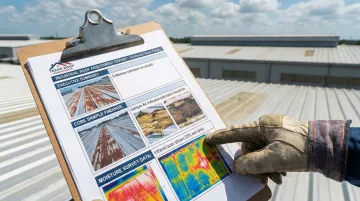
The decision: ERS applied an ASTEC coating system including rust-inhibiting primer and multiple protective layers. The project took three weeks with zero production downtime, cost approximately 35% of the full replacement quote, and achieved a 20-year renewable warranty.
When inspection confirms structural integrity and moisture saturation stays below critical thresholds, treatment preserves operations — and at 35% of replacement cost, the financial case is straightforward.
If your facility is showing similar signs, a professional inspection is the first step. ERS provides roof assessments for industrial facilities across Southeast Texas — reach them at 281-404-2211.
Conclusion
Corrosion treatment is the right call for industrial roofs with surface-level deterioration, intact structure, and remaining service life. It preserves operations, reduces cost by 50–70%, and extends protection 10–15 years. Full replacement is the right call when structural integrity or moisture saturation has crossed critical thresholds—particularly the 25% moisture rule or when through-metal corrosion is present.
For industrial facilities in Houston, Conroe, Baytown, and across Southeast Texas, humidity and heat accelerate metal roof corrosion faster than most owners expect. Acting on early warning signs is what separates a $200,000 coating project from a $1.2 million replacement.
The difference almost always comes down to catching deterioration before it reaches structural components. A professional inspection and moisture survey is a small upfront cost that routinely drives six-figure decisions—in the right direction. Engineered Roofing Systems has handled exactly these assessments for industrial facilities across Southeast Texas since 2000, helping owners choose the right path before the choice gets made for them.
Frequently Asked Questions
What is the 25% rule in roofing?
The 25% rule is an industry threshold where if moisture surveys reveal 25% or more of a roof's substrate is saturated, full replacement is typically recommended over coating. Applying coatings over that level of moisture traps water and accelerates deterioration, often voiding manufacturer warranties.
How long does an industrial roof last?
Standing seam metal roofs last 60+ years, EPDM membrane systems 25-40 years, and PVC membranes 20-30+ years under normal conditions. Proactive corrosion treatment and maintenance programs can push each of these ranges further.
Can a roofer apply corrosion treatment coating when it's too hot or cold outside?
Most roof coatings have temperature application windows—typically above 50°F and below 110-120°F depending on chemistry. Extremely hot Texas summers (above 110°F) or rare cold snaps can affect adhesion and cure times, so experienced contractors plan application windows around seasonal conditions and match the coating chemistry to the forecast.
Can roof coating actually stop rust on a metal roof?
Yes, when properly applied. A thorough corrosion treatment process including rust-inhibiting primers (often zinc-rich formulations) and encapsulating coating layers can halt active surface oxidation and prevent further rust progression. However, it requires aggressive surface preparation and cannot reverse through-metal structural corrosion.
How do I know if my industrial roof needs treatment or full replacement?
Replacement is warranted when you find structural deck corrosion, moisture saturation above 25%, persistent leaks that resist repair, or a roof past its rated service life. Surface rust on a structurally sound deck with low moisture content typically qualifies for treatment instead.
How much does industrial roof corrosion treatment cost compared to full replacement?
Corrosion treatment runs $2.00-$7.00 per square foot, while full replacement—including tear-off, disposal, and reinstallation—runs $8.00-$20.00+. On a 100,000 square foot roof, that's roughly $200,000-$700,000 for treatment versus $800,000-$2,000,000 for replacement.