Introduction
You've patched the same leak three times this year. Another one appeared last week after the storm. The invoices keep piling up, and you're starting to wonder: should you keep throwing money at repairs, or is it time to commit to replacing the whole roof?
For facility managers and building owners across Southeast Texas, it's a real financial decision with consequences either way. Invest too heavily in repairs on a dying roof and you're burning capital. Replace prematurely when a restoration would have held, and you've overspent by tens of thousands.
Texas's punishing climate makes the stakes higher — extreme heat, relentless UV exposure, and year-round humidity accelerate roof deterioration faster than most other regions in the country.
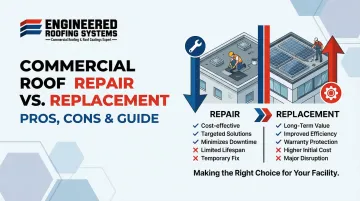
This guide breaks down the pros and cons of repair versus replacement, introduces a third option that often goes unconsidered (roof coatings and restoration), and provides a practical decision framework to help you make the right call for your facility.
Key Takeaways
- Repair works best for localized damage affecting under 25% of the roof, with structure intact
- Replace when the roof is near end-of-life, moisture has penetrated the deck, or repair costs are compounding
- Roof coatings extend life by 10–20 years at a fraction of replacement cost
- Roof age, damage extent, repair frequency, and energy performance goals all determine which path saves you more money
- A professional inspection is the essential first step before committing to repair, coating, or replacement
Repair vs. Replacement: Quick Comparison
Use this table as a starting point — the right choice depends on your roof's condition, budget, and how long you need it to last.
| Factor | Repair | Replacement | Coatings/Restoration |
|---|---|---|---|
| Upfront Cost | Low to moderate ($3–$10/sq ft) | High ($11–$16/sq ft for single-ply) | Moderate ($4–$11/sq ft) |
| Lifespan Extension | 1–5 years per incident | 20–25+ years | 10–20 years |
| Business Disruption | Minimal | Heavy equipment, noise, downtime | Low to moderate |
| Best For | Isolated, early-stage damage | End-of-life or severely compromised roofs | Structurally sound but aging membranes |
| Tax Treatment | Deductible as current-year expense | Capitalized and depreciated | Varies (consult your advisor) |
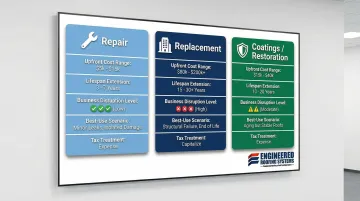
Tax note: Repairs are generally deductible immediately, while replacements must be capitalized and depreciated over time. Confirm the treatment with your tax advisor.
When Commercial Roof Repair Is the Right Call
A repair addresses isolated damage without overhauling the entire system—think targeted patching, seam resealing, flashing replacement, or small membrane sections.
The 25% Rule
If less than a quarter of your roof surface shows damage or moisture saturation, targeted repair is typically the most cost-effective path. Look for:
- Localized leaks after storms
- Loose or corroded flashing around vents and edges
- Minor ponding near a single drain
- Isolated membrane punctures or seam failures
Pros of Repair
- Lowest upfront cost, typically $3–$10 per square foot
- Fastest turnaround with minimal project timeline
- Minimal business interruption — no heavy equipment or extended downtime
- Extends roof life significantly when damage is caught early
Cons of Repair
- Treats symptoms, not root causes
- Costs compound quickly if repairs become frequent
- Does nothing to improve energy efficiency or aging insulation
- May void or complicate warranty coverage on older systems
When Repair Stops Making Financial Sense
These cons add up fast. Most roofing professionals use the following thresholds to flag when a repair cycle has become a liability:
- Annual repair costs approach 10-15% of total replacement cost
- The same area requires more than two repairs in one year
- Repair frequency escalates from occasional to routine
According to NRCA lifecycle cost analysis, frequent repair cycles on aging roofs can cost nearly double over the long term compared to investing in a quality replacement upfront. When repairs become routine rather than occasional, the roof is telling you something the patches can't fix.
When Full Roof Replacement Makes More Sense
Conditions That Make Replacement Unavoidable
Replace when you see:
- Moisture penetration into insulation or structural deck
- Widespread membrane blistering or shrinkage covering large portions
- Sagging interior ceilings or water stains
- Rusted steel decking visible from inside
- Multiple leak points across different roof areas
The Age Factor
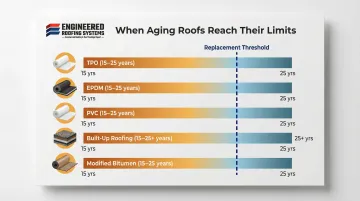
Most commercial membrane systems have predictable lifespans:
- TPO, EPDM, PVC: 15–25 years
- Built-Up Roofing (BUR): 15–25+ years
- Modified Bitumen: 15–25 years
When a roof approaches or exceeds its expected lifespan, repairs address symptoms rather than the underlying deterioration. Roofs past 20 years typically develop systemic failures — failing seams, saturated insulation, degraded membrane — that no amount of patching can resolve long-term.
Pros of Replacement
- Fresh start with a modern, energy-efficient system
- New manufacturer warranty (typically 20–30 years)
- Access to cool roof materials that reduce HVAC costs
- Eliminates the cycle of repeated service calls
- Potential to increase property value
Cons of Replacement
- High upfront cost ($11–$16/sq ft for single-ply membranes)
- Significant business disruption during installation
- Longer project timeline
- Spreads capital expenditure over years rather than offering an immediate tax write-off
Financial Framing: Think Lifecycle, Not Just Upfront
That upfront sticker price looks different when measured against 20–30 years of operating costs. Modern cool roof systems can reduce annual cooling costs by 10–30% in hot climates like Southeast Texas — a figure worth factoring into any honest cost comparison.
NIST Handbook 135 recommends evaluating building envelope investments using lifecycle cost analysis over 20–40 years. Run the numbers over the full roof lifespan, not just the installation invoice.
The Third Option: Roof Coatings and Restoration
What Is Roof Restoration?
Roof restoration involves applying a fluid-applied, seamless waterproofing system over an existing structurally sound membrane. Unlike a temporary patch, it's a fully engineered solution that encapsulates the existing roof and adds a new protective layer.
When Does a Roof Qualify?
Your roof is a candidate for restoration when:
- The deck and insulation are intact
- The membrane is weathered but not structurally failed
- Leaks recur in multiple areas but aren't from deep moisture intrusion
- The roof has been in service 10–15 years and shows age but isn't at end-of-life
A professional moisture assessment is critical before choosing this path.
Key Benefits
- Adds 10–20 years of service life at a fraction of replacement cost
- Eliminates seams as potential leak points, creating a continuous waterproof barrier
- Reflective coatings reduce heat absorption and lower cooling costs — silicone coatings run $5–$9 per square foot and hold up well against Southeast Texas's summer heat
- Requires far less downtime than a full tear-off and replacement
ERS Restoration Expertise
Engineered Roofing Systems (ERS) handles roof coatings and restoration for commercial and industrial facilities across Southeast Texas. As an authorized contractor for Versico, Carlisle, Duro-Last, and ASTEC, ERS's restoration work is backed by manufacturer warranties of up to 30 years — with less disruption and cost than a full replacement.
Limitations
That said, coatings aren't suitable for every roof. If the insulation is wet, the deck is compromised, or there are more than two existing layers already in place, restoration won't work as a standalone solution.
Making the Final Decision: A Practical Framework
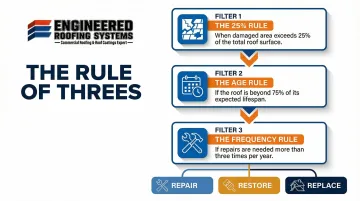
The Rule of Threes
Use these three filters to narrow your decision quickly:
1. The 25% Rule: If more than a quarter of the roof is damaged, repair costs rival restoration or replacement.
2. The Age Rule: If the roof is within 5 years of its expected end-of-life, heavy investment in repairs is rarely a sound investment.
3. The Frequency Rule: If you've needed two or more significant repairs in the past 12 months, you're likely dealing with systemic failure.
Situational Guidance
Choose Repair When:
- Damage is isolated and affects less than 25% of the surface
- The roof is under 10 years old
- Structure and insulation are sound
- This is the first or second repair in recent years
Choose Restoration/Coatings When:
- The roof is 10–18 years old
- Structurally intact but showing age-related wear across multiple areas
- You want to extend life by 10–20 years without full replacement
- Energy efficiency improvements are a priority
Choose Replacement When:
- The roof is beyond its service life (20+ years for most systems)
- Deep moisture damage has reached the deck or insulation
- Lifecycle cost analysis shows repair/restoration costs outpacing a fresh investment
- You need a 20–30 year warranty and no surprise repair bills down the road
Start With a Professional Inspection
These frameworks point you in a direction — but the right call depends on your roof's actual condition. Engineered Roofing Systems provides professional assessments for commercial and industrial facilities across Southeast Texas, helping owners commit to a path based on honest findings, not guesswork.
Contact ERS today to schedule your free roof inspection and get a recommendation specific to your facility's condition and budget.
Frequently Asked Questions
How much does commercial roof repair cost compared to full replacement?
Repairs typically cost $3–$10 per square foot depending on scope, while full replacements run $11–$16 per square foot for single-ply systems. When you factor in repeated repairs over time, full replacement or restoration frequently costs less over the roof's lifecycle.
How do I know if my commercial roof needs repair or replacement?
Key indicators include localized vs. widespread damage, roof age relative to expected lifespan, frequency of repairs in the past year, and whether moisture has reached the deck or insulation. A professional inspection is the most reliable way to assess this.
What is the typical lifespan of a commercial flat roof?
Most commercial membrane systems (TPO, EPDM, PVC) last 20–25 years under good maintenance, while metal roofs can last longer. Neglected roofs often fail well short of that window. Consistent maintenance is what gets you to the 25-year mark.
Can a roof coating extend the life of my commercial roof instead of replacing it?
When the deck and insulation are structurally sound, a roof coating or restoration system can add 10–20 years of service life for significantly less than a full replacement. Certified contractors can back these systems with long-term manufacturer warranties.
Does commercial roof repair affect my existing warranty?
Improper or unauthorized repairs can void manufacturer warranties. Use certified contractors and document all maintenance and repairs. Some warranties require regular professional inspections to remain valid.
How often should a commercial roof be inspected?
At minimum twice per year (spring and fall), plus after any major storm event. Regular inspections catch minor issues before they become costly repairs — and they keep your warranty coverage intact.