
Introduction
Dallas commercial property owners face a relentless challenge: flat roofs take a beating from intense Texas heat, frequent hailstorms, and heavy summer rains. The Dallas-Fort Worth metroplex sits on a volatile atmospheric dryline that produces 7 to 9 days of damaging hail annually, making roof repair costs a significant and recurring budget concern. In 2024 alone, Texas experienced 878 major hail events, with a single June 2023 storm generating between $7 billion and $10 billion in insured losses across the DFW area.
Commercial flat roof repair costs in Dallas vary widely—from a few hundred dollars for a minor patch to $15,000 or more for extensive membrane work. This guide breaks down what drives those numbers: repair type, roof size, material, and damage severity—so you can budget accurately and decide when a patch is enough versus when a full section replacement makes more sense.
Key Takeaways
- Commercial flat roof repair in Dallas typically costs $300–$15,000+ depending on repair type and damage scope
- Costs vary most by roof material, damage extent, roof size, and post-storm labor demand
- Minor repairs (patches, small leaks) cost $300–$900; major membrane or structural repairs push costs to $5,000+
- Getting multiple quotes and scheduling routine maintenance keeps long-term repair costs down
How Much Does Commercial Flat Roof Repair Cost in Dallas, TX?
Flat roof repair costs vary widely based on damage scope, materials, and site conditions. That variability trips up a lot of building owners: delaying repairs because a quote seems high allows damage to compound fast, while taking the lowest bid without checking contractor credentials often leads to repeat repairs within months.
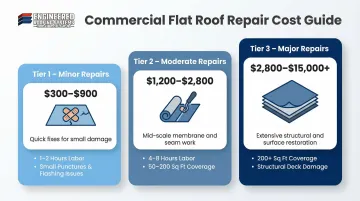
Typical Cost Ranges for Dallas Commercial Flat Roof Repairs
Minor repairs (small leaks, isolated membrane punctures, minor flashing issues):
- Cost: $300–$900
- Covers 1–2 hours of labor, patching materials, and basic sealant work
- Common causes: dropped tools, foot traffic, storm debris
Moderate repairs (50–200 sq ft of damage — seam failures, drain repairs, localized membrane replacement):
- Cost: $1,200–$2,800
- Involves 4–8 hours of labor and more extensive material replacement
- Typical scenarios: flashing deterioration, pipe boot failures, localized seam separation
Major repairs (large membrane sections, structural deck damage, widespread ponding remediation, 200+ sq ft affected):
- Cost: $2,800–$15,000+
- May blur into partial re-roofing territory
- Requires thorough on-site assessment and often involves wet insulation removal
Most quotes cover the basics — but knowing what falls outside a standard scope prevents surprises on the final invoice.
What's typically included:
- Labor and standard repair materials
- Basic site clean-up
- Temporary weatherproofing during repair
What's typically excluded:
- Municipal permit fees
- Structural decking repairs
- Insulation upgrades
- Crane or lift rentals ($200–$1,000+ per day)
- Post-repair inspection fees
Dallas-specific pricing factors: The DFW market runs slightly higher than rural Texas due to strong demand and post-storm surge pricing. While the Bureau of Labor Statistics reports mean hourly wages for roofers at $22.51–$24.79, fully burdened crew rates (including workers' comp, insurance, and overhead) typically run $85–$150 per hour per worker.
Key Factors That Drive Flat Roof Repair Costs in Dallas
The final repair bill is shaped by technical, site-specific, and market factors. Knowing each one helps property owners evaluate quotes with confidence.
Roof Material and Membrane Type
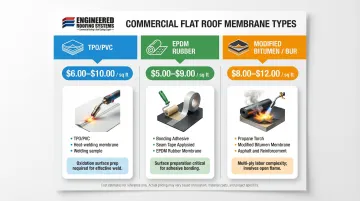
The membrane type directly affects both material cost and labor complexity:
| Membrane Type | Repair Cost (per sq ft) | Labor Characteristics |
|---|---|---|
| TPO / PVC | $6.00–$10.00 | Requires precise heat-welding; surface must be cleaned of oxidation before hot-air welder can fuse patch |
| EPDM (Rubber) | $5.00–$9.00 | Uses adhesives and seam tapes; labor-intensive surface prep required for proper bonding |
| Modified Bitumen / BUR | $8.00–$12.00 | Multi-ply systems requiring messy, labor-intensive repairs using roofing cement or torch-applied patches |
Extent and Type of Damage
Surface-level damage (small puncture, isolated blister) costs far less than damage that has compromised membrane seams, insulation, or roof deck. What looks minor from the ground is often more extensive once a contractor inspects up close. Hidden water intrusion is a frequent cost escalator in Dallas, driven by heavy summer rains. Once moisture saturates the insulation layer, repair costs can multiply tenfold.
Roof Size and Number of Penetrations
Total square footage drives material costs. The number of HVAC units, drains, vents, and skylights adds complexity on top of that. Each penetration point is a potential failure zone requiring careful resealing, which increases both labor time and cost.
Dallas Climate and Weather Impact
Texas climate factors affect both repair frequency and cost:
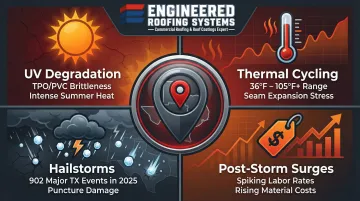
- UV degradation: Intense summer heat accelerates membrane aging through plasticizer migration in TPO/PVC systems, causing brittleness and shrinkage
- Thermal cycling: Temperature swings from 36°F winter lows to 105°F+ summer highs create expansion/contraction stress on seams
- Hailstorms: 902 major hail events in Texas in 2025 create punctures demanding immediate attention
- Post-storm surges: Material lead times and labor rates temporarily spike after major weather events
Contractor Credentials and Access Logistics
Certified commercial roofing contractors (authorized by manufacturers like Versico, Duro-Last, or ASTEC) may charge more per hour but often provide manufacturer-backed warranties on repairs, covering both materials and workmanship for the life of the system. Multi-story buildings or roofs with restricted access require additional equipment (lifts, scaffolding) that increases job cost.
Types of Commercial Flat Roof Repairs and Their Costs
Not all flat roof repairs are equal. The type of repair needed determines both the method and the price. Dallas commercial roofs experience a predictable set of failure points.
Leak Patching and Puncture Repair
Cost: $200–$1,000 for approximately 100 sq ft
This is the most common and lowest-cost repair: sealing isolated punctures or blisters in the membrane caused by foot traffic, hail, or debris. The repair itself is quick, but locating the true source requires professional inspection — water travels horizontally beneath the membrane before appearing on the ceiling.
What affects the final cost:
- Size and number of punctures or blisters
- Membrane type (TPO, EPDM, modified bitumen)
- Accessibility and roof height
Seam and Flashing Repair
Cost: $450–$1,200+
Seams and flashings (where the roof meets walls, curbs, HVAC bases, and drains) are the most common failure points on aging commercial flat roofs in Dallas. Failed seams are a leading cause of interior water damage. Repair costs vary:
- Basic wall/parapet flashing reseal: $450–$900
- Complex chimney or specialty flashing: $900–$1,200+
Membrane Section Replacement
Cost: $1,000–$5,000 for 100–500 sq ft sections
When damage to a defined membrane section is too extensive for patching — typically after hail damage or localized age failure — cutting out and replacing that section becomes necessary. As a rough rule, once repair costs exceed 30–40% of a partial re-roof quote, replacement becomes the better investment.
Drain, Ponding Water, and Structural Deck Repairs
Clogged or failed roof drains create ponding water, which accelerates membrane degradation and adds significant structural load, a frequent issue given the intensity of Dallas summer storms.
Costs:
- Basic drain reseal: $800–$1,200
- Full drain rebuild (cutting membrane, replacing drain body): $1,800–$2,500 per drain
- Wet or rotted decking replacement: Additional $2,000–$5,000+ depending on extent
If water has penetrated to the deck, replacement of compromised decking material is a separate cost item that should be quoted separately.
Repair vs. Coating vs. Full Replacement — How to Know Which You Need
Dallas property owners often face a three-way decision: repair a specific problem area, apply a full roof coating system, or proceed with full replacement. The cost difference is significant, making the right diagnosis critical.
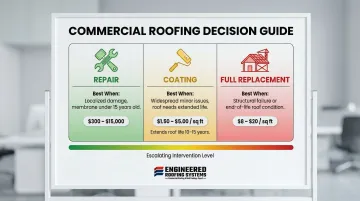
When repair is the right call:
- Damage is localized to specific areas
- Membrane is generally in good condition (under 15 years old, no widespread seam failures)
- Repair will realistically extend roof life by 5+ years without repeated interventions
When repair is just a band-aid:
- Widespread membrane failure across multiple zones
- Multiple active leaks in different locations
- Decking damage indicating systemic failure
- Roof approaching or past its expected lifespan
Roof coatings as a middle path:
Silicone and acrylic coating systems $1.50–$5.00 per sq ft installed in DFW can seal minor widespread issues, add UV protection, and extend roof life by 10–15 years — often at less than half the cost of full replacement.
ASTEC coating systems are a proven option when the membrane is deteriorating but structurally sound, helping commercial properties avoid full tear-offs while cutting cooling costs through reflective white surfaces.
Important caveat: Coatings should only be applied after infrared moisture scans ($0.05–$0.12/sq ft) confirm the underlying insulation is dry. Coating over wet insulation traps moisture and accelerates deterioration.
Full replacement indicators:
In DFW, commercial roof replacement averages $8–$20 per square foot. Common triggers include:
- Structural decking failure requiring tear-off to bare deck
- Multiple failed repairs with no lasting improvement
- Roof past 20–25 years with no coating history
Dallas's adoption of the 2021 International Energy Conservation Code (IECC) mandates insulation R-value upgrades during full tear-offs, adding to overall project costs.
What Most Property Owners Get Wrong About Commercial Flat Roof Repair Costs
The Cost of Delaying a Simple Repair
Delaying an $800 patch repair in Dallas can turn into a $6,000–$10,000 membrane section replacement within one or two Texas storm seasons. Water intrusion compounds quickly once the membrane is breached. Establish a proactive inspection cadence—at minimum twice per year, plus after major hail events.
Low Bids That End Up Costing More
The Dallas commercial flat roofing market includes both certified specialty contractors and general contractors with limited flat roof experience. The latter may use incorrect repair methods or incompatible materials that void existing warranties or fail within a year.
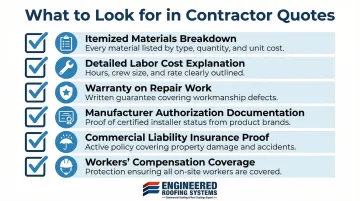
What to look for in contractor quotes:
- Itemized materials breakdown
- Detailed labor cost explanation
- Warranty on repair work (separate from material warranty)
- Manufacturer authorization documentation
- Proof of commercial liability insurance
- Workers' compensation coverage
Repair Cost vs. Remaining Roof Life
Every repair quote should be evaluated against the roof's remaining useful life. A $3,000 repair on a roof with 2 years of remaining life is a poor investment compared to a coating or re-roof that adds 15 years. Request a written roof condition assessment alongside any repair quote. Companies like Engineered Roofing Systems provide long-term maintenance programs designed to help commercial clients manage costs across the roof's full lifecycle.
Storm Damage Claims: Don't Skip This Step
Many commercial flat roof repairs in Dallas resulting from hail or wind damage may be covered — partially or in full under commercial property insurance—but only if the claim is filed promptly and documented correctly. Texas insurers increasingly apply cosmetic hail damage exclusions, requiring thorough documentation to prove functional damage.
Involve your insurance provider before starting any storm-related repair. Document damage with:
- Pre- and post-storm photos
- Infrared moisture scans
- Core samples (when damage depth is in question)
Frequently Asked Questions
What is the average cost to repair a commercial flat roof in Dallas, TX?
Commercial flat roof repairs in Dallas range from $300 for minor puncture patches to $15,000+ for extensive membrane section replacements with structural work. The Dallas market reflects Texas labor and material pricing, with post-storm surges temporarily increasing costs. Get a professional inspection for an accurate estimate based on your specific damage.
How much does it cost to replace a commercial flat roof per square foot?
Full commercial roof replacement in the DFW area averages $8–$20 per square foot, significantly higher than repair costs of $5–$12 per square foot for localized work. Replacement makes sense when widespread damage, multiple active leaks, or a roof past its expected lifespan makes repair or coating no longer viable.
What is the typical lifespan of a commercial flat roof?
Expected lifespans by material: TPO (15–25 years), EPDM (20–30 years), Modified Bitumen (10–20 years), and BUR (15–30 years). Dallas's intense UV exposure and extreme thermal cycling can reduce these lifespans without proper maintenance and timely repairs, making proactive inspection critical.
What types of flat roof repairs are most common for Dallas commercial buildings?
Dallas's 7–9 damaging hail days per year and intense UV exposure drive most repair calls. The most frequent issues include:
- Leak patching from hail punctures
- Seam and flashing resealing due to thermal stress
- Drain clearing and repair after heavy rains
- Post-hail membrane section replacement
Is a roof coating a cheaper alternative to flat roof repair in Dallas?
Coatings are not a direct substitute for targeted repairs but can be cost-effective when a roof has minor, widespread issues. At $1.50–$5.00 per square foot, coatings are often cheaper than multiple individual repairs and can extend roof life by 10–15 years while reducing cooling costs through reflective surfaces.
How do I know if my commercial flat roof needs repair or full replacement?
Key indicators: localized damage suggests repair; widespread damage across multiple zones indicates replacement. Consider membrane age, number of active leaks, and whether structural deck damage is present. A professional roof assessment using infrared scanning and visual inspection is the most reliable way to determine the right path.