
Cost varies widely based on roof size, material, pitch, location, and whether you're dealing with a residential home or a commercial facility. This guide breaks down 2026 pricing ranges, what actually drives those numbers, and how to budget correctly before you call a contractor.
TL;DR
- National average: $9,607; most projects fall between $5,902–$46,000 (Angi, 2026)
- Per square foot: typically $4–$11, with premium materials running higher
- Costs rise with steep pitches, multiple tear-off layers, permits, and complex roof lines
- Asphalt and off-season timing stay lower; metal, tile, slate, and large commercial roofs sit at the top
- Higher upfront spend pays off when it adds decades of service life or manufacturer-backed warranty coverage
How Much Does a Full Roof Replacement Cost in 2026? (Pricing Overview)
There's no single price tag for a "roof replacement." Total cost depends on roof size, system type, access, and local labor rates. 2026 market data still shows wide spreads across all three.
Common mistakes that blow budgets:
- Underestimating total project cost by only pricing materials, not labor
- Choosing a material mismatched to climate or building use (asphalt on a flat industrial roof, for example)
- Skipping a budget line for hidden decking or structural repairs
Typical Cost Range
| Tier | 2026 Range | Source |
|---|---|---|
| Entry-level (basic system, simple layout) | $5,800–$20,000 | Angi |
| Mid-range (standard single-ply or metal) | $6,000–$25,000 | HomeAdvisor (2025 data) |
| High-end (premium membrane/metal, large commercial) | $8,500–$30,000+ | Angi 2026 |
These ranges typically include materials, labor, and standard tear-off. They typically exclude permits, structural repairs, and decking replacement — costs that often surprise first-time commercial buyers.
Published national bands are a starting point. Larger commercial and industrial roofs are usually priced by the square, and total job cost often rises with footprint, insulation, and deck repairs.

Entry-Level Range
Covers basic materials, single-layer tear-off, and standard install on a simple roof layout. Best for smaller commercial buildings, short-hold assets, or owners who need a functional reroof without premium system upgrades.
Mid-Range
Includes durable single-ply or standard metal systems, solid manufacturer warranty coverage, and moderately complex install details. Best for most commercial and industrial buildings that need dependable, warranty-backed performance without paying top-tier premiums.
High-End Range
Premium membrane or metal systems, longer manufacturer warranties, and complex detailing or large-building logistics. Best for harsh-climate sites, high-value facilities, or industrial roofs that need 20–30 year warranty-backed performance.
Key Factors That Affect Full Roof Replacement Cost
Pricing comes down to four drivers: material, size and pitch, tear-off and deck condition, and local labor and permits.
Roofing Material
- Asphalt: $1-$1.20/sq. ft. materials only; lasts 10-20 years (NerdWallet)
- Metal: $6-$16/sq. ft. materials only; lasts 50-75 years
- Tile: $10-$20/sq. ft. materials only; lasts 50-100 years
- TPO/single-ply membrane: $4.50-$16/sq. ft. installed (Angi)
Industrial and commercial facilities almost always use single-ply membrane systems (TPO, PVC) instead of residential shingles, since low-slope roofs need seamless, weather-sealed coverage rather than layered shingles.

Roof Size and Pitch
Square footage scales material and labor costs directly: bigger roof, more of everything. Pitch matters too. Angi reports steep roofs cost 10% more on average, and unusually steep or complex roof lines can add $1,000-$3,000 for extra safety equipment and time. On commercial low-slope roofs, complexity more often shows up in penetrations, drainage, and access than in steep pitch.
Tear-Off and Decking Condition
Removing one layer of old roofing costs $1-$5/sq. ft. (Angi). Multiple layers mean more labor, more disposal fees, and a higher chance of discovering rotted or unstable decking mid-project, a cost most facility managers don't budget for until it's already happened.
Permits, Labor Rates, and Location
Permit fees run $100-$1,400 depending on your city, and labor typically runs $40-$90 per hour per worker. Commercial and industrial roofs often need contractors with manufacturer-certified installation status.
Engineered Roofing Systems, for example, is an authorized installer for Versico, Carlisle, Duro-Last, and ASTEC systems. That certification matters because manufacturer-backed warranties (sometimes up to 30 years) usually require the installation to follow the manufacturer's exact specifications.
Cost Breakdown of a Full Roof Replacement
A quoted price isn't one number. It's several cost categories stacked together.
| Component | Type | Typical Cost |
|---|---|---|
| Materials | One-time | $1.50-$20/sq. ft. depending on material |
| Labor and installation | One-time | ~60% of total project cost |
| Tear-off and disposal | One-time | $1–$5/sq. ft., scaled to roof size and layers removed |
| Permits and inspections | One-time | $100-$1,400 |
| Maintenance and warranty | Recurring | Varies by manufacturer program |
Labor is usually the single biggest line item—often about 60% of total project cost on a full commercial replacement.

What typically moves each line:
- Materials — membrane or coating system, insulation, and total squares
- Labor — access, height, deck condition, and work around active operations
- Tear-off — existing layers, substrate repairs, and disposal fees
- Permits — local jurisdiction and project scope
On membrane and coating systems, maintenance programs and manufacturer warranties protect that investment for decades after the crew leaves.
Should You Repair or Replace? Making the Right Call for 2026
A rough rule many contractors use: if repair costs approach a third or more of full replacement, replacement is usually the smarter long-term play.
Some jurisdictions (Florida, for instance) codify similar thresholds around 25% for code compliance, so check your local building code rather than assuming a universal number.
Age matters too. As a rough guide:
- Commercial asphalt and built-up roofs nearing 15-20 years are often replacement candidates
- Metal roofs can often go 50-75 years before replacement makes sense
- Membrane systems (TPO, PVC, EPDM): replacement timing depends on product and maintenance history
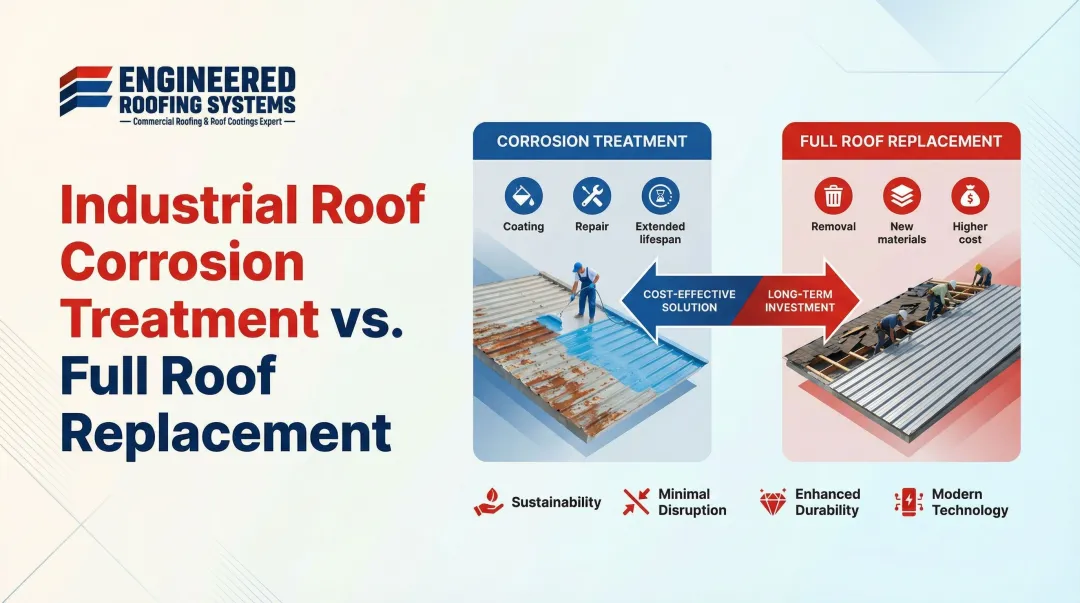
For commercial and industrial buildings, a full tear-off isn't always necessary. Roof coating systems can extend roof life and delay a major capital expense.
Engineered Roofing Systems built its original business (Energy Coating Systems) around this approach: fixing localized leaks, membrane punctures, and seam failures with coatings and partial repairs before a full replacement is warranted.
A no-obligation inspection typically checks:
- Drainage and ponding water
- Flashing and seam condition
- Membrane health and fastener integrity
- Structural condition of the deck
Coating systems like ASTEC's fluid-applied Re-Ply install directly over an existing roof, sealing joints and penetrations without tear-off, and can carry renewable warranties.

How to Estimate the Right Budget for Your Roof Replacement
Chasing the lowest quote is how budgets go sideways. Match your budget to your property type, climate exposure, and how long you plan to own the building instead.
Weigh these factors before you set a number:
- Roof size and complexity (roof lines add cost beyond raw square footage)
- Material lifespan versus upfront cost (cheaper now can mean replacing sooner)
- Local climate demands (Gulf Coast heat, humidity, and storms wear roofs differently than a dry climate)
- Warranty coverage needed for your risk tolerance
Get at least 3-4 quotes using a standardized scope of work. Comparing apples to oranges (one quote with tear-off included, another without) is the fastest way to pick the wrong contractor.
For commercial and industrial properties, minimizing operational disruption matters as much as price. A facility manager can't afford a crew that shuts down production for a week longer than necessary. Engineered Roofing Systems brings 50+ years of combined experience across that kind of work, from a 450,000-square-foot warehouse reroof in Houston to railcar repair facility coatings in Sheldon and Cleveland, Texas. That range of scale is what helps set realistic budget expectations before work starts.
Frequently Asked Questions
What is the average cost to replace a roof?
The 2026 national average is $9,607, with most projects falling between $5,902 and $46,000 depending on material and roof size. Per square foot, expect $4-$11 on average (Angi, 2026).
How much does it cost to replace a roof on a 2,000 sq ft house?
Expect roughly $8,000-$22,000 installed, depending on material choice. Asphalt sits at the lower end while metal or tile push toward the top of that range.
Is $30,000 too much to replace a roof?
It depends entirely on the material and scope. For a large slate or high-end metal roof, $30,000 fits right within typical ranges. For a basic asphalt job on an average-size home, that price is on the high side and worth questioning.
How many quotes should you get for a roof replacement?
Get three to four quotes from reputable contractors using a standardized scope of work. That way you compare materials and workmanship on equal terms, not mismatched scopes.
Can you replace just part of a roof?
Yes, when damage is localized and the rest of the roof is in good condition. Full replacement becomes necessary when damage is widespread, the roof is near the end of its lifespan, or structural issues compromise performance beyond a cost-effective repair.
Can you put a new metal roof over an old metal roof?
Sometimes. Feasibility depends on the existing roof's structural support, slope, and current condition, plus local code allowances. An inspection is required to confirm whether a recover job is possible or a full tear-off is needed.